Tim Van Horn & The Canadian Mosaic Project
December 31, 2010 | Filed Under Interview, Personal Project, Photo Studios and Work Spaces, Road Trip | Leave a Comment
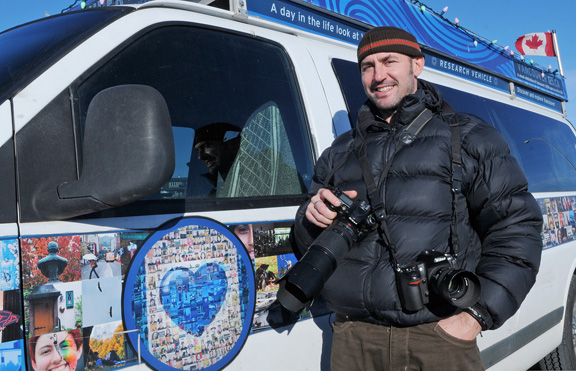
I met up with photographer Tim Van Horn for a coffee today but forgot to bring a mug so I was out of luck. When you live in a small camperized van, room for everything, including extra dishes just isn’t there.
I don’t know how you’ll be celebrating the new year but for Van Horn Jan. 1, 2011 will mark 27 months on the road for the Alberta photographer and he’ll celebrate that milestone in Victoria. The 41-year-old photographer has been traveling across the country in his van photographing Canadians, 5000 so far, for his Canadian Mosaic project. His plan is to stay on the road until he captures 25,000 portraits that he will use to create a giant Canadian flag mosaic in time for the country’s 150th birthday on July 1, 2017. Van Horn, who has travelled from Newfoundland to Nunavut for his project, expects to spend the next few weeks in the greater Victoria area.
You have to admire Tim as he is doing what so many of us talk about but never get around to actually acting on, hitting the road and just working on a project, taking photographs everyday.
His work can be seen at http://celebratecanada.wordpress.com/.
Merry Christmas
December 24, 2010 | Filed Under Uncategorized | 1 Comment
Merry Christmas to all, posting will pick up after the holiday.
Thanks for visiting.
Viewfinder – The State of Photojournalism
December 15, 2010 | Filed Under Blog | Leave a Comment
Todd Korol pointed me to this BBC blog called Viewfinder by Phil Coomes, a photographer and picture editor for the BBC News website. All this week he’s running a series of posts about the state of photojournalism. Today’s posting, the third, about funding photojournalism with Panos Pictures Adrian Evans, is appropriate given my last post about Mike Andrew McLean and his experiment with Kickstarter. Excellent pieces earlier with Michael Kamber and David Campbell. You can check out David Campbell’s website here. His work looks extremely interesting.
Mike Andrew McLean – Range: Mountain Park Photographs & Kickstarter
December 14, 2010 | Filed Under Gallery & Workshop, Ideas | Leave a Comment
I’ve heard of photographers using crowd sourcing as a source of funding but only third hand. Yesterday I received this email from photographer Mike Andrew McLean and thought I’d pass it along. It’s an interesting concept, using Kickstarter, for an interesting project and with even just a $10 donation you get a print:
I am pleased to announce that Range, the photo project I’ve been working
on for the past three years, will be exhibited in its entirety at the
Southern Alberta Art Gallery in July 2011 (a selection will also be
exhibited at the Kamloops Art Gallery this January).
Due to the costs associated with the production of the exhibition, I
researched some alternative funding avenues and discovered Kickstarter.
My project was launched today on the Kickstarter website, so please have a
look!
http://www.kickstarter.com/projects/1058706563/range-mountain-national-park-photographs
If you are willing to make a pledge, you will receive some amazing
incentives not the least of which will be my eternal gratitude. Also,
it would be wonderful if you would consider forwarding this link to anyone
else who may be interested.
If you have any questions, or need more info, please let me know.
Thanks for your consideration,
Mike
Colin Corneau – Interview
December 13, 2010 | Filed Under Interview | Leave a Comment
1) How did you become a photojournalist?
The short answer is dumb luck. The longer answer is that I grew up always having a visual aptitude. Before I discovered cameras in high school it was drawing or sketching but that always seemed too slow. I’m only half-joking when I say I took up photography because I was too impatient to create a picture by drawing.
I was very lucky to have ended up going to a high school that offered a solid vocational program in photography; around that time, I became really fascinated by the idea of a photojournalist or a newspaper photographer — nothing else could possibly be as interesting as portraying real life, and things that were actually happening.
Those early days gave me the technical ability to understand how to take a picture and it pretty much was a process of learn-by-doing (ie. a million mistakes) over many years that I learned how to make a picture.
One other big stroke of luck was being in Winnipeg at a time when both newspapers had a lot of great photographers on staff. Every day I got to read the paper and see what these familiar names were doing, and that just made me want to do it more. I eventually got to know most of those names and I’m very grateful for what they taught me, mostly by quiet example.
2) You’ve worked quite a while in Brandon, Manitoba. It’s a smaller city and somewhat isolated, so what’s kept you there?
I love being a photographer at a daily newspaper. That fascination with portraying everyday life is still as valid and strong now as it was long ago. I also appreciate stability and security; I think that once basic needs are met and secured, I can then branch out and explore other interests and projects sustainably over a longer term.
There’s been plenty of angst and worry, wondering if I’m missing out on the wider world this way. But in going to conferences and talking to other photographers over the years, it occurred to me that the things they complained and worried about were remarkably similar. I’m not sure there’s any peace in this world, but I do think you can choose to be happy and fulfilled wherever you are. In recent years, I’ve honed my thoughts about the meaning of community and that’s from familiarity — those are two words that inform a lot of what I photograph and why.

3) Like many photographers you have personal projects on the go. One project you’ve been working on for a while is China. What’s the attraction there for you?
It didn’t start out as a project but I guess like the best ones, it evolved into that. I’d probably use the word “exploration” myself. I simply was curious about something and set out to learn about it. I talked to people, read as many books as I could find, devoured all the articles I could about China and Chinese culture. It was a pretty easy subject to be captivated by — an ancient culture undergoing unprecedented change, with unheard-of speed. The recent history alone of China is astounding — epic and tragic on a scale we can’t imagine here.
Just like my education in photography, I found a few happy coincidences soon into my journey. One was an exchange at the university here in my city, where a professor from Nanjing came to teach Mandarin language classes. I signed up, but ironically was interrupted by my first trip to China in late 2002. I had friends there, which helped a lot.
Step by step, over the years, one thing led to another. Since I interpret the world through photography, it was only fitting I’d apply that to experiencing China. I found a subject that I was constantly interested in, and the images I made there are very special to me, even if there was never any particular plan in making them!
I think most photographers are curious about the world. I’m curious about China and so it’s been very rewarding to combine two big passions.
4) You shoot film for the China project. Why?
When I first visited China, we only had film cameras. I’ve shot a little bit of digital over there since, but mostly it’s been film-based. When I go to China, it’s for me…I’ve never been hired or commissioned to go there (but would love that), and I’ve relied on my personal holiday time from my work to do so. I’m not complaining about that — on the contrary I’m grateful to be so lucky to have a job that allows me to pursue this interest.
Film feels tangible to me, it feels substantive. Maybe it’s just psychological but I approach things differently when I use film — perhaps more slowly or methodically. Maybe it’s just nice to have a little extra reminder that I don’t need to rush to meet a deadline. The tools themselves are different (lenses, cameras) and so the image, naturally, looks unique. That’s a big part of it.When I use film, I’m doing something for me, on my time and on my terms. It seems to set things apart, in my mind. I also like crafting an image in black-and-white, with all the rewards that come from manual labour. And, interestingly, it’s not that much extra labour, when you factor in the whole process of digital imaging from start to finish.
I’m no Luddite, I just think the world is a big enough place for both mediums.

5) Sometimes you work with a panoramic camera. What appeals to you about the format?
I’ve worked with a Widelux F7, for a series of images that eventually became an exhiibition of China photographs. I now have an XPan camera — both shoot regular 35mm film. Not every situation ‘feels’ right for this format, but it’s one that seems to suit much of my impressions of China. On a basic level, I feel like there’s so much going on in China that I can’t fit it all into a normal format.
I also really like the idea of breaking out of boundaries normally imposed on photography, even if only in format size. So much is made of new lenses, sensors, and other details of cameras that few people ever realize they’re locked into what manufacturers determine for them. I suppose a person could stitch together separate images digitally, or crop a commonly-proportioned image dramatically, but that’s a pale imitation, I think. A panoramic camera sets out from the start to make a specific kind of image — that’s what I’m interested in, because I think at certain times that’s what’s in front of me.
6) Do you print your own images? What process(es) do you use?
I do ‘wet print’ my own images in the darkroom, although I don’t want to limit myself to that. As I said, I love the craft of making a photograph by hand. I have a lot to learn about that process, but when it’s done right there’s nothing like it. They’re true individuals, each print — especially when you tone the images, as I like to do with selenium and mild sepia. Most of my photographs shot on film are printed this way.
There’s no crime in involving digital processes, to make a hybrid workflow. It depends on each image — there’s no point in retreating to stubborn dogma…whatever works, is what I’m interested in. For those times I scan in images (or for images made on a digital camera) I enlist the help of a few terrific commercial photographers I know here in Brandon, and their printers. I just can’t afford those things right now.
7) Do you have more trips to China planned?
I know I’ll go back sometime, but for now it’s probably best to pay off the bills from the last few times I went there!

8) You’re also shooting images in Brandon that are separate from your newspaper work. Can you tell us about those images?
This is my latest project, and it’s been going on for a little over 2 years now. I live in my city’s downtown, and walk to and from work each day. I got to know the community (there’s that word again) from walking daily and thought I should carry a camera to capture some of the odd things I’d see occasionally.
My favorite focal length is a 35mm lens (in 35mm format) and as cliché as it sounds for street photography I thought black-and-white film felt right. Partly, this was because I could work on it myself on my own time, and partly because of what I mentioned about my China photography — the notion of making it separate and distinct from my day-to-day work.
There was no plan or idea with this project at the outset. I simply did it for the joy and fun of making pictures…I guess it was the photographic equivalent of doodling absentmindedly on a sheet of paper.
Over time, I noticed more and more ‘moments’ and thought I may as well do something with it all. I’m still not totally sure what, exactly, that would be but for now I’m putting them on my blog (www.reservedatalltimes.com) and I think it would be fun and useful to do an exhibition at some future point.
I’ve been inspired a lot by the street photography of Fred Herzog, in Vancouver and especially John Paskievich of Winnipeg with his terrific book “The North End”. I don’t kid myself about coming close to that level of work, but I do like the idea of preserving a community and a time. It seems a lot of photography is, at one level or another, about fighting back against the relentless tide of time erasing everything. Well-crafted and passionate photography can let us hold a moment and examine it later on, and things we’d otherwise forget or even belittle can have a second chance.
On that point, I also remember a scene from Canadian graphic novelist/cartoonist Seth’s book “It’s a Good Life If You Don’t Weaken”. He had a “walk in the snow” moment where he realized his love of abandoned, decaying old buildings was tied to his lamenting the passing of time. I’m not sure if I’m quite that nostalgic, but I think that urge is behind a lot of this type of photography.
9) Are there any other projects you’re working on?
I’m on the Visual Arts committee of our local Folk Music and Arts Society, and each year we do a portrait project. It ties in nicely with my feelings about the importance of community and how the arts can help foster that. So, there’s something new each year with that.
I’d like to pursue arts grants in the future, although I’ve learned enough in my initial research to see that it’s almost a full time job applying and following up on various grants. It’s definitely not “free money” as some uninformed people might think!
Down the road, I’d like to renew an interest in wetplate collodion photography. I love the idea of an extinct process existing in the 21st century, but I’m really fascinated by its uses for portraiture as photography is a way I reach out to others.

10) Your website is currently just a cover page, will we be able to see a full website soon?
Yes, but I’m run a bit off my feet with work and other photography now. And mostly, I’m running short of funds too! I’m working with a colleague at my paper to get a site up, but my desire is that it’s visually well crafted and stand out to a graphic designer. I’d like any site I have to really be strong from a design perspective, as well as being a clear representation of my photography.
My goal is to have my site up and running early in the New Year.
BLOG – www.reservedatalltimes.com
SITE – www.colincorneau.com
Wrong Side Of The Tracks – Ian Willms
December 12, 2010 | Filed Under Blog, Landscape | Leave a Comment
An interesting set of moody images titled Wrong Side of the Tracks from Ian Willms of Boreal Collective.
George Webber – Interview
December 8, 2010 | Filed Under Interview | Leave a Comment
I think of myself as a documentary photographer. Photography is a wonderful medium for harvesting up stories from the stuff of daily life.

2) You have a brand new book out entitled Last Call published by Rocky Mountain Books. What is the book about?
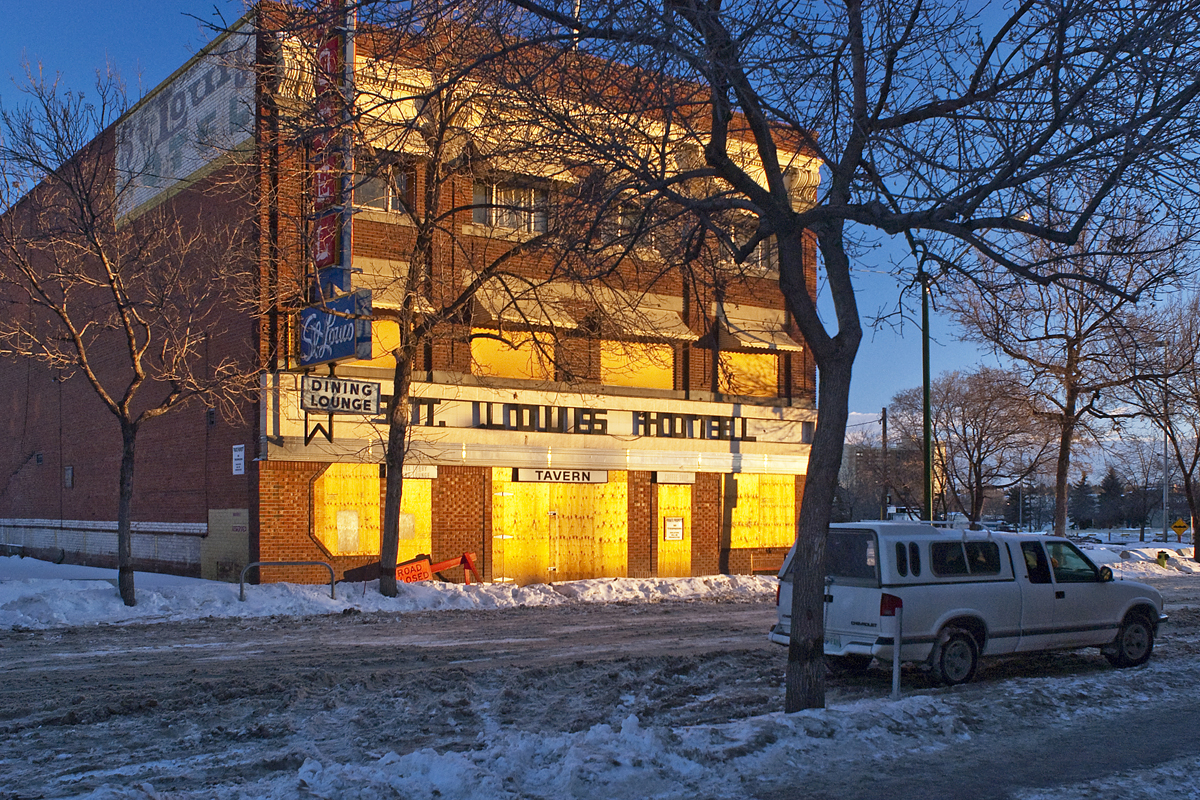
LAST CALL tells the story of the final years of Calgary’s notorious East Village, a feral little precinct situated smack behind Calgary’s cobalt blue city hall. The East Village was best known for its shabby hotels, the St Louis, King Edward and Cecil that formed an un-holy trinity and an affront to Calgary’s Mayor and many members of city council.
You went to the East Village if you needed a cheap room or you wanted to deal for booze, drugs or sex. Some nights you went in hopes of a long shot paying off.
Like the night a guy sitting at one of the back tables in The St Louis suggesting to his beer soaked buddy, a rumpled local TV news reporter that he might want to consider a
run for civic politics
Through heavy lidded eyes the reporter turned the idea over in his head.
His name was Ralph Klein. It wasn’t long before he was Alberta’s Premier.

3) How long did you work on that project? What were some of the challenges in creating the images.
I spent the years of 2004 – 2009 photographing in the East Village. The biggest challenge in this kind of work is winning the trust and respect of the people you wish to photograph. You have to earn it. That takes time.
4) You’ve photographed prairie towns for a long time, in fact you seem to have two separate bodies of work that focus on the subject. You’ve photographed disappearing towns, remnant of towns or even towns that no longer exist and the black white images while beautiful have a somber, at times sad feel to them. At the same time you’ve been photographing small town architecture in colour which seem to be perhaps more upbeat. Can you talk about these two projects and how they fit together?
The choice of black and white vs. colour is a matter of intuition, judgment and experience. Which one will be capable of conveying the subject most powerfully? Colour is closer to reality, capable of a kind of exquisite transcription. Black and white is more distanced from reality, more abstract, capable of a kind of poetry. The rich, allusive subject matter of these disappearing places calls out for both.
5) Your work in a number of your projects (Calgary’s East Village, Prairie towns, People of the Blood) has recorded, if not way of life, a least a slice of life that has vanished and/or changed dramatically. Do you feel drawn to this type of story or were you just interested in the subject and it all changed around you.
I have a powerful attraction to the sharpness and poignancy of endings. Life is so often about endings, about losing things….photography is about keeping them….for just a bit longer.
6) In contrast to your more recent projects one of your early documentaries, focusing on the Hutterites , featured a subject ( a conservative religious sect that clings to the past in many ways) that didn’t change. Can you talk about that?
A girlfriend once said to me, “You have an infinite appetite for inspiration.” She was right. Time with the Hutterites was filled with stories and lessons, most of them unspoken. You can learn a lot about courage, compassion and commitment from the Hutterite people. The fundamentals don’t really change much on a Hutterite Colony. That’s what make a day there so dear.
7) You exhibit your work as fine art on a regular basis and your style is most often referred to as documentary. Do you think there is any distinction between fine art and documentary photography?
Names like “Fine Art” and “Documentary” can be convenient ways to categorize photography but just exactly where would you put Eugene Atget, or William Eggleston, or Lee Friedlander, or Diane Arbus or August Sander? Their work can be said to have grown out of the Documentary tradition but it surely transcends that tradition and it stands as some of the most enduring and important art of the twentieth century. Photography is like a great river. It’s most powerful current is the documentary current.
8) Most photographers have routines when they work on a project. What are some of yours?
I like to photograph where it’s quiet, when there’s not much going on. That often means getting up early or staying out until the light’s all gone. I like to travel light, usually one camera with one lens. I like to hang out. I like to go back to the same place over and over again. I like to watch for the little changes.
9) You have exhibited a lot and have had numerous books published. Which is the greater challenge, getting a book published or arranging exhibitions?
I just try to do justice to the reality of the things that I photograph and care about. When I’ve completed a project I try to bring the work to the attention of curators and publishers. I’m very grateful for the support and encouragement I’ve received in recent years. Traditional book publishing is facing some challenges right now but you might also consider this a golden age in book publishing. The breadth and quality of work available now is extraordinary. The hard part isn’t getting the work published or exhibited. The hard part is creating work that deserves to be published or exhibited. Good work will always find an audience.
10) You teach some photography classes, what’s the attraction of teaching for you?
Energy, passion, commitment and decency are things that students can bring into the classroom. It doesn’t happen all the time. But when it does, it feels pretty good to be around.
To see a preview of Last Call, go to Youtube.com and type in Last Call by George Webber. You can see more of George Webber’s work here.
Omen of Bones
December 6, 2010 | Filed Under Omen of Bones, Personal Project | 1 Comment
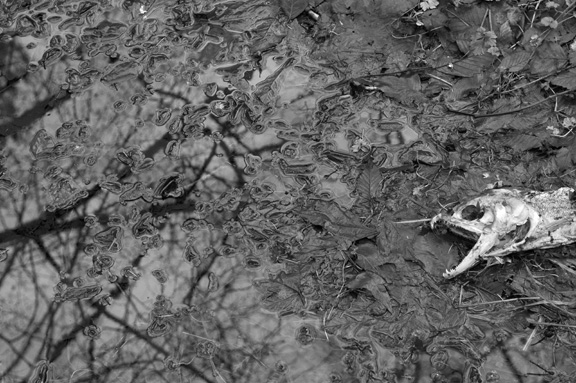
I’ve been working on a project the past few years, shooting every fall when the salmon return to spawn. These aren’t the images you always see of scarlet bodied fish fighting their way upstream but instead are images of the dead and decaying bodies of the spawned out fish.
I’ve been calling this project Omen of Bones and when people ask me what it’s about I tell them The End Of The World. You can almost see the eyes rolling, as I’m sure yours are right now. However, I’m not talking about aliens invading earth, all out nuclear war, or a giant meteor striking the planet end of the world kind of event. I’m talking about death by a thousand cuts end of the world. That’s the way I see it, we’ll go with a whimper not a bang. A little bit disappears here, a little bit there.
Most of us are familiar with salmon as a resource, a source of food for man and beast and we’re all (mostly) aware that salmon stocks have been dwindling over the past decades. Studies (private and government) and some steps at conservation haven’t stopped the trend. Some people got quite excited earlier this year when an early run of fish, which spawn in British Columbia’s interior, came through in record breaking numbers, an unprecedented event but that’s all it was, an anomaly, a freak show that won’t be repeated.
This year I didn’t get out to check the rivers until late and I’d already heard the Goldstream run was way way down in numbers but even so I was shocked by how few bodies were on the shore and in the river.
What most people don’t realize is that it’s not just as a food source as living animals that make the salmon important but it’s their contribution to the general environment after they die that impacts the world as well. The bodies provide nutrients in the river water needed for the growth of other species. They fertilize the ground not just immediately next to a river but for miles around (animals and birds carry the carcasses).
That’s why I’ve been photographing the bodies, trying to draw some attention to an equally important part of the lifecycle of the salmon as well as their impact on entire ecosystem they inhabit.
We tend to view death as something terrible but for the salmon, it’s a needed part of their life cycle, they spawn and die, ensuring another generation lives on. Their death also ensures life goes on for a myriad of other life forms and without them we all die a little.
There’s also a certain bleak beauty in these images, images of death AND life, if you know what you’re looking at.
One more for Christmas
December 6, 2010 | Filed Under Gifts | Leave a Comment
I forgot to mention one of my favourite online shops for very odd photo gifts. It’s called Photojojo and you can check out the goods here at the store. Who couldn’t use a juice box camera (above) , just push the straw to snap the shutter, or a tiny tiny model camera or maybe a mount so you can carry a camera on your bike helmet (both below)
Photo Books, Beer Toques And A Poster
December 5, 2010 | Filed Under Photo Book | Leave a Comment
Looking for another idea for Christmas presents, check out all the self published photobooks from the Self Publish Be Happy shop.
If you’re looking for a non-photo related stocking stuffer, how about something as truly Canadian as a toque or tuque, however you like to spell it. These toques though aren’t for keeping your head warm, they’re for keeping your beer cold. Check out The Drink Toque here.
One last suggestion, if you can’t afford an original print from Magnum’s Australian photographer Trent Parke, you can certainly afford a poster created from one of his photographs, available for $10 from Little Brown Mushroom Books.
Don Denton is a photographer, photo editor and photo coach who lives in Victoria, British Columbia.