Claire Martin – Interview
January 26, 2011 | Filed Under Interview | Leave a Comment
1) Please introduce yourself. Who is Claire Martin?
Just a girl from Perth Australia, nothing special bout that really
2) You?re in Haiti right now. What are you doing there?
Every now and then I feel compelled to sink my teeth into a personal project or give myself a new work challenge, where I can follow my own
story and develop it in my own style. I have always intended to work within an international market and I felt I had to get out of Australia
and photograph something that is internationally relevant. So aside from these self indulgent urges to further my international career, I actually
care to tell the story of those displaced by the tragic earthquake. When I first heard about the earthquake I felt an instant urge to go, but I
restrained myself because there was already so many media people there reporting. I figured I could potentially be more of a strain on their
fragile infrastructure and do more harm than good, so I decided to postpone and look at it from an aftermath perspective. Although the
international media would loose it’s attention span for Haiti, the suffering would be around for a long time! I am focusing on life in the
tent cities. Much of my work to date has focused on marginalized communities and internal displacement and the culture of these tent cities
resonates with these themes that run through my work.
3) Last year you won the Inge Morath award for your essays on Vancouver?’s Downtown East Side and California?s Slab City. Let?s talk
about the first essay. What is your connection to Canada and how did you end up photographing in the Downtown East Side? Can you talk a little
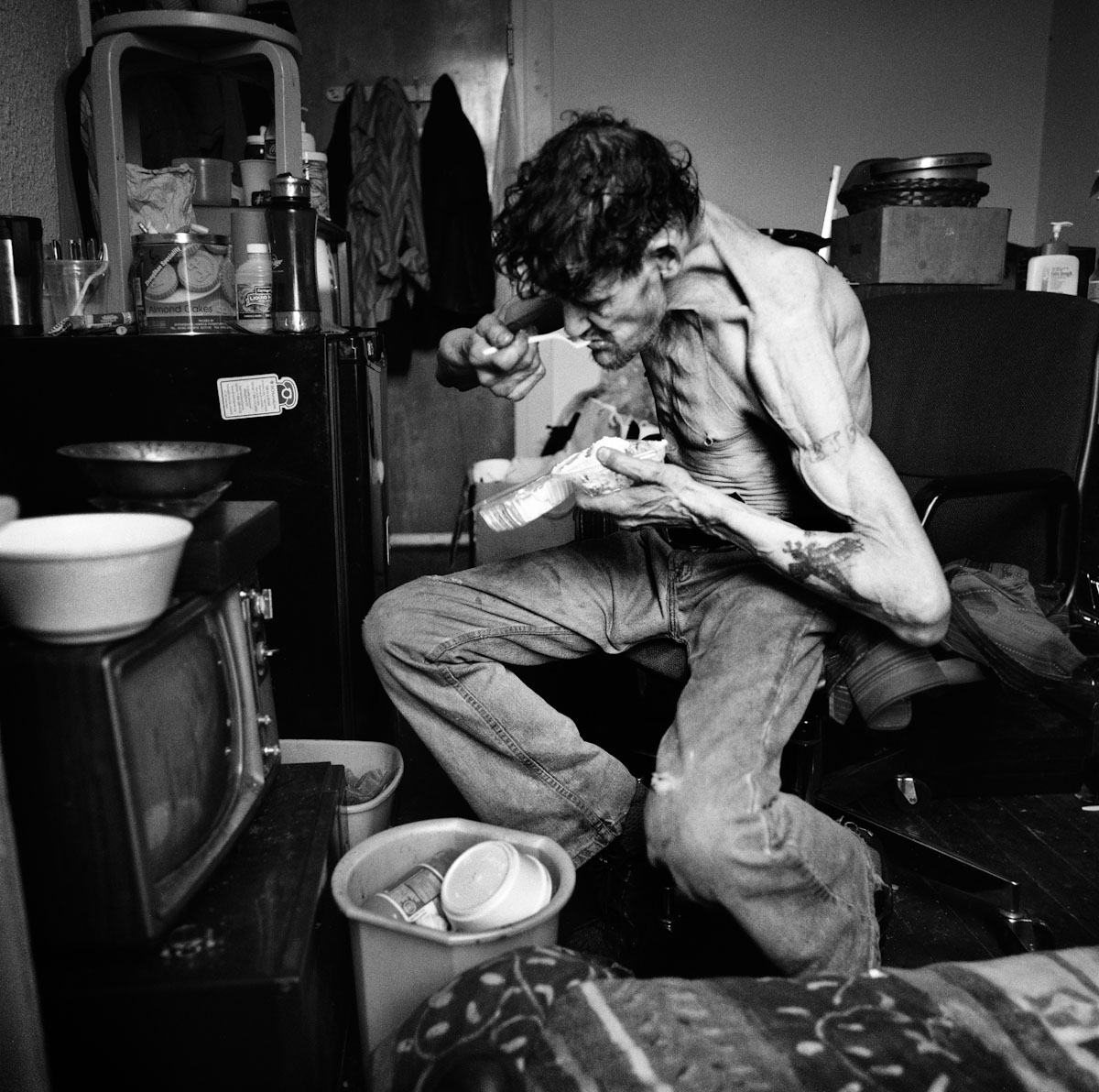
about the main image we’ve seen from that essay, of the man eating who seems somehow to be both emaciated and yet very muscular?
I moved to Vancouver with a 1 year work VISA just for something to do. And the “Cheap Hostel” I booked online turned out to be practically one of the
half way homes on the border of the Downtown East Side. I wasn’t practicing as a photographer at this point, I had just taken a bunch of
photo’s during my travels. At this time I wasn’t thinking about telling stories or making comment on anything but I kind of knew I wanted to do
this type of thing, and when by chance I landed in this community I knew it would be a story I would want to tell. At university I studied Social
work and have always been interested in working with the marginalized people, and I’ve witnessed the problems of addiction personally so I felt
I it was a story I could tell if I tried.
About Tony? I met him and we just had a rapport. It’s a great thing when you meet someone who really want’s their story told and who is uninhibited
in front a camera. Tony was 50 at the time and had been addicted to Heroin for over 25 years. He has AIDS and lost his wife to an overdose. he also
had twin girls who were born HIV positive and were taken away by the state shortly after they were born. Despite these addiction induced problems he
is unable to quit using. In the photograph he is eating cream pie that I brought for him. I recently had an email from a woman who works in the
DTES who saw the photo and knows Tony, she gave me an update on him. She said “He is battling with AIDs and his brother has Leukemia and has
recently been in and out of the hospital. We haven’t seen Tony since before Christmas, so I don’t know how his brother (or him) is doing now.
We have seen Tony go through rehab and gain 20 lbs and slowly deteriorate again. “
I sincerely hope he is ok. He really wanted to be a a good person but his addiction compromises his ability to be this way.
4) How much time did you spend on both essays? It seems it would take a great deal of time to build up the rapport and trust to make the
intimate images you did.
Well, the Vancouver series I shot in my spare time. I was working as a chef and would hang out down there on some of my days off. I was shot over
maybe a year? But the progress was slow as I had never done this type of photography before. At first I didn’t even really know how to approach someone and ask for a picture. I was lucky to find a friend and mentor at the same time (Lung Liu – Amazing photographer) who trained me in visual story telling and introduced me to the work of today’s documentary photographers. It’s through studying others work, that I have learned about the way I want to shoot.
The Slab City series I spent about 6 weeks camping in the community with intermittent “sanity and sanitation” trips to LA. It seems a long time and
hopefully I have more confidence in my ability to create stories on a tighter time frame than this now, but rule of thumb, the more time you can
invest, the better and more authentic the outcome.
5) What did winning the Inge Morath award mean to you? How did it affect your career?
I was just reading a BJP article about funding work through grants, I could pretty much copy and paste it here to elaborate. I’m still in what
I’d say is the “emerging phase” of my photographic practice even thoughsaying that makes me sound like a wanker …. I’m not at the level that
this guy is at, but it’s the same principle. Here’s a link to the article
http://www.bjp-online.com/british-journal-of-photography/feature/1938739/tips-2011-writing-grant-application (Article is by Don Weber)
So basically, yes, it’s fantastic because it gives you credit, cash and material for your CV, but it also means you have to work harder to keep
proving it was worth it for me to receive it. At first I thought with one award people would be knocking on my door. The press from various awards
has indirectly brought assignments my way, but it isn’t a magic wand, it’s a link in the chain.
6) 2010 appears to have been a very good year for you. You were accepted as the newest member of Oculi, the Australian collective. How did
that come about and why did you want to be a member of Oculi?
I had never worked as a photographer in Australia prior to returning home from my time over seas, so I really had no idea about the industry there.
I’d looked at what was going on and saw that Oculi was really the only collective working predominantly in a documentary style. They also have a great reputation with award winning photographers and distribution through Agency VU and Redux. I’d always worked on my own but felt it was time to join up with others and be in an environment where I can learn from my peers. I didn’t bother contacting them about membership because I figured
they were exclusive, but they saw my work exhibited at Foto Freo, an international photography festival and invited me to join. I was thrilled
because they view photography in the same way I do and it’s quite rare. Most agencies are very commercially based.
7) Australia and Canada have a lot of similarities, both are Commonwealth countries with decent economies and educational standards.
Australia, however, on the arts front, seems to have far more galleries and institutions devoted to photography. What do you think? Do you see
more support for photography in Australia?
Haha, I’d say this is a case of the grass is greener syndrome… I honestly think Canada and Australia are really very similar in a lot of
ways. Arts scene or lack there of, included. Then again, there are a few great festivals here and some large photography prizes. But really I think
it’s about the same. The benefit here is that it is a small scene so if you’re doing good work and putting it in front of the right people, you will
be recognized.
8) You have three essays on your web site, Downtown East Side, Slab City and Salton Sea. The first two are about people while Salton Sea seems
to be about landscape and remains of previous existence. What appealed to you about the Salton Sea?
I like the surreal and the unusual. I don’t always want my work to be too literal. I also like things that are good and bad in equal measures. I
like to show ying and yang in in my work. Not things that are just pretty, or just dark. I like the complexity of the balance and as a landscape this
area has that same duality that I look for in communities or in people. It is really a very ugly place, stinking of rubbish and left derelict and
unwanted, but with all the natural beauty of a desert lake landscape. It’s a visual contradiction, this a more interesting landscape to me than one
that is just pretty. It also has an interesting historical and environmental story.
9) Crowd sourcing, an alternate source of raising funds for projects, has started to become popular recently. You are currently using the
IndieGoGo site to raise funds for work in Haiti. Why did you decide to try this route and how do you feel about the results so far?
Honestly it has taken a while to come around to the benefits of social networking and marketing your work in this way, but I’ve realized that I
can’t fossilize with the dinosaurs and that I need to have a modern and diverse business model in order to survive in this industry. I researched
it a little and saw that there was a high success rate for funding, that many reputable photographers are funding their personal work in this way
and that the system is based on commerce, not charity. It is through the pre-sale of limited edition prints that I fund my project, so there is a valuable exchange. I am happy with the result so far. I hope I can reach my goal! (Claire’s IndieGoGo link)
10) Finally, can you talk a little about how you work? Do you do a lot of research before you begin a project? Do you work with minimal equipment
or do you carry lots of backup gear? How do you know when you?re done?
Well the work on my website is personal work, so I have complete authorship over the content, the way the story is told, the visual style,
etc and I really love to shoot this way. I love to tell stories the way I see them as oppose to translating another person’s vision, which is what
you often have to do when on assignment. I have my own unique way of seeing a situation / the world and to me it really is story telling and
I’m the author. As it’s documentary work, I’m allowed to have a perspective and an opinion and for the work to be emotional which is
frowned upon is straight journalism which is supposed to be objective and based on facts and events. By way of research, honestly I don’t do too
much. I usually try and put something together. I always have an idea of the story I will shoot, but it ALWAYS changes completely when I am
actually shooting. I go in with an idea and a plan, just so I at least have a point to be there, but I always expect the outcome to be different.
I’m quite opportunistic and intuitive in the way I work.
Re: Equipment. I’m a minimalist. One body, one lens, one tripod, maybe a flash, sometimes
some filters. I hate carrying too much shit around. I feel like a pack horse and not a photographer. It gets in the way for me. I work the shots
to the equipment I have as oppose to the other way around. Mostly I’m done when my time is up – when my plane leaves. I look forward to trying to
find a local project I can keep returning to over a period of years. There’s no need to rush personal work.
You can find more of Claire Martin’s work here.
Claire Martin and IndieGoGo – funding her Haitian Life project
January 12, 2011 | Filed Under Funding, Personal Project | Leave a Comment
About a month ago I wrote about crowd sourcing to fund photo projects and Victoria photographer Mike Andrew McLean and his use of Kickstarter to fund his project The Range.
Since then I’ve come across another good example, Australian photographer, and Oculi member, Claire Martin is currently photographing in Haiti and she’s using IndieGoGo to create a funding program for that work. You can follow her work in Haiti and see some of her images on the accompanying blog.
I hadn’t heard about IndieGoGo before but the site is easy to navigate and certainly has a punchier front page than does Kickstarter.
Crowd sourcing does seem to be a viable way for photographers to raise funds (and for fund contributors to get books, prints, postcards or even a personal call from the photographer) and it’s interesting to see that not only younger less well known photographers are using this method. Magnum photographer Larry Towell has a Kickstarter site up for his Afghanistan work.
TJ Watt – Interview
January 11, 2011 | Filed Under Interview, Photography | 3 Comments
1) Who is TJ Watt?
Born, raised, and living in beautiful Metchosin, BC, he is on a quest to protect BC’s world class ancient forests through visual media and public outreach. He spends his free time skateboarding, climbing trees, dancing through the night, and staring curiously at the stars.
2) I think it’s safe to say your photography is mainly related to your interest in environmental protection. Can you explain why?
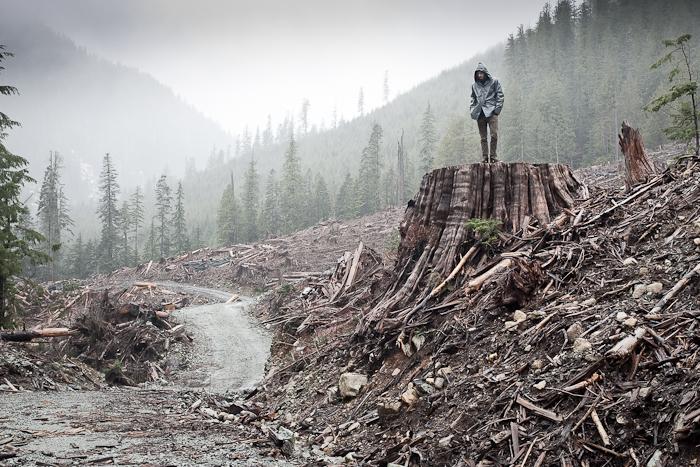
Well it seems to have evolved naturally in that direction over the past few years. It’s basically a melding of my interest in landscape photography with my strong passion for conservation work and exploring the wilderness of BC. Instead of just taking pretty pictures I started to see it would be much more valuable if they served a higher purpose at the same time. Photography is a very powerful tool for raising environmental awareness in many ways but I think one of the most critical points is its ability to bring very remote or hidden places to the public’s eye. My work focus’s mainly on the threats to BC’s endangered old-growth forests and often times I am taking photos where less than and a handful of people have been if any at all. The dense rainforest’s of Vancouver Island are largely unexplored so it’s amazing to share images from these virtually unknown places. If you can’t bring the 4 million plus citizens of British Columbia to the woods then you need to bring the woods to them and now, with the power of GPS mapping and Google Earth, you can extend that concept to the entire world.

3) You’ve actually, with a couple of others, started your own environmental group. What is the focus of that group and how did it start?
At the start of 2010, Ken Wu, the former Campaign Director for the Western Canada Wilderness Committee along with myself and a few other activists launched a new ENGO called the Ancient Forest Alliance. In our first year we have become the fastest growing environmental group in Canada with nearly 20,000 supporters joining on with us. The organization’s goal is to be the driving force in the fight to protect BC’s endangered ancient forests and forestry jobs. We’re pushing to see old-growth forests protected where they are scarce such as Vancouver Island and the Southern Mainland, a transition to sustainable second-growth logging instead, a ban on raw log exports, and the creation of more value added wood manufacturing facilities. Our group differs as well in that we chose not to have charitable status which allows us to be much more political. We are exercising that power in one way by helping start Ancient Forest Committees that will work in key provincial swing ridings to put pressure on politicians around their forest policies. You can find us on Facebook, on Twitter, and at www.ancientforestalliance.org Don’t forget to sign the petition as well at www.ancientforestpetition.com !

4) You work in some fairly difficult terrain and the west coast forests can be both wet and dark. What are some of your photography challenges?
That is true! As beautiful and enchanting as the temperate rainforest is, it has its many photographic challenges. The first and foremost struggle is just moving through it. Next time you’re on a boardwalk in Carmanah Provincial Park or the rainforest trail in Tofino, take a look off to the side and imagine bush whacking through the under story while carrying 30 pounds of gear with you. The forest can be incredibly dense with 6ft tall salal bushes, sharp branches poking your eyes, steep slippery cliffs, sinkholes, and not to mention giant fallen trees that even on their side can be twice as tall as you and over 200ft long. It’s perfect leg breaking territory. The second test is found in the name rainforest itself. Rain! Lots of it! Trying to keep yourself and your expensive gear dry is at times impossible and makes changing lenses, batteries, and memory cards a scary task. The last challenge might sound off but it is the sun. It seems strange to complain about it after whining about the rain but it can be just as frustrating. The patchwork of openings in the forest canopy causes the light to be very mottled on the forest floor. The contrast from light to dark is often times too wide a range for the camera and makes for a very distracting scene. The ideal day is overcast with the sun just about shining through right after a light rain shower which gets everything rich in color.
Oh, and a tripod is a must too!

5) Your work is about the west coast landscape, are there any other areas in the world you’d like to photograph?
To be honest, I am quite obsessed with the forests of BC and could be happy taking photos here forever but if I had to choose some other places I might say somewhere like Iceland. I love its dramatic and desolate landscapes, giant mountains, and exploding volcanoes. It almost appears from another planet. Recently I was down in Argentina and Chile and crossing the Andes was an incredible experience. It’s like getting a trip through canyons on Mars. The red, yellow, and black color of the soil in contrast with ice blue glacial lakes was just spectacular. I would also find it fascinating to photograph in abandoned urban areas that are slowly decaying and being reclaimed by nature. It’s a great reminder of our own impermanence.
6) Are there other photographers whose photography is centered around protection of the natural environment that you admire?
Most definitely. In this province the work of people like Garth Lenz and Ian McAllister really stand out. Garth has documented BC’s rainforests and the effects of industrial forestry for nearly two decades and has more recently focused his aerial photography on the Alberta tar sands. It was exciting to have him as a teacher at Western Academy of Photography and I was happy to hear he was recently accepted into the International League of Conservation Photographers. Ian works with a group called Pacific Wild and has done an absolutely stunning job of photographing the wildlife in the Great Bear Rainforest on BC’s coast. His shots of wolves and grizzlies are breathtaking and have helped tremendously in raising awareness about the complexity and fragility of that areas ecosystems.

7) Do you do any other photography to supplement your environmental work?
In the sense of weddings or advertising, etc, no. It doesn’t really work for me. If I can find a way to make a personal connection with a project, even if it’s out of my usual field, I may try to take it on. It can be a fun new challenge stepping out of the norm for awhile but I mostly stick to my main focus.
I find that most of my interesting new experiences come from the combination of my environmental campaign work and my own photography leading to opportunities I may have otherwise missed. With the power of the internet people from all over the world can stumble upon your images and next thing you know you’re on to something new as well.

Most photographers have personal projects. You photograph abandoned mattresses. Tell us about that?
Haha, yes. I have a thing for abandoned places and objects. The collecting of mattress photos started while I was living in Toronto for a year and one day noticed just how many were strewn about the streets and alley ways. It was like they had been invisible before I became aware of them and then they were just everywhere. I think what I find most interesting about them is that you never see anyone in the actual process of abandoning one. You will be driving down a rural road somewhere and there will just be one looking shiny and new leaning up against and old rotting fence. Or there will be one out alone in the middle of a soccer field with the spotlights shining eerily on it at night as if it just teleported there. Even though I am sure people dump them in a hurried or careless way, each one ends up taking on its own unique aesthetic as to how it fits into the scene. And then they just disappear.

9) You also buy old cameras from thrift shops and process any film found inside. Why?
I haven’t done this in awhile but it sure is fun. I find it odd that people could leave film inside a camera and toss it away with their pictures inside it. Maybe they forgot or just didn’t care but for me it becomes a surprise peek into another world. It’s really like reaching into a stocking on Christmas because you just don’t know what you’ll pull out. I have found some pretty funny photos in the rolls. I’m sure many of them seem funny though only because you don’t have any context for the scenes you’re looking at. You find some beautiful ones too like this one roll of old expired disc film that had someone’s travel pictures on it. There were these lovely scenes of fields with rainbows, giant mountains, and old buildings mixed with all the distorted colors from the old film. It would be great to put a collection of them together for a show.

10) What will 2011 bring for TJ Watt?
That’s an exciting thought! I’m really hoping it brings plenty of adventure and opportunities to work with more new and interesting people doing progressive things. 2010 was the most exciting year of photography for me so far as working with the Ancient Forest Alliance has finally allowed me to really focus on what I love instead of doing random jobs and trying to run out into the woods on weekends. We have plans to undertake many more expeditions into the valleys and forests of the mid and north of Vancouver Island. There really is so much more to be explored out there. A couple of books should be in the works as well along with the startup of a new eco-tourism based business I am working on. Keep your eyes peeled!
You can see more of TJ Watt’s work here.

Donald Weber’s INTERROGATIONS
January 1, 2011 | Filed Under Photo Book | Leave a Comment
Documentary photographer, and rising art star (check out the 12 page spread in the Fall 2010 edition of Canadian Art magazine) Donald Weber has a new book INTERROGATIONS coming out in the fall of 2011. Published by Schilt Publishing, features more of Weber’s images from Eastern Europe.
The following, from the release for the book, explains Weber’s work:
‘Interrogations is the result of his personal quest to uncover the hidden meaning of the bloody 20th Century. In dialogue with writer Larry Frolick – whose own ancestors had been decimated in the final months of WW II – Weber insistently and provocatively addresses his questions both to the living survivors and to the ghosts of the State’s innumerable victims, resurrecting their final hours by taking their point of view, and performing a kind of incantatory meditation over their private encounters with Power.
The policemen, working girls, thugs, dissidents and hustlers who inhabit these pages are all orphans of a secret History; the outlines of our collective fate takes shape in Weber’s epic work, expanding our awareness of what it means to be an actor in today’s dark opera.
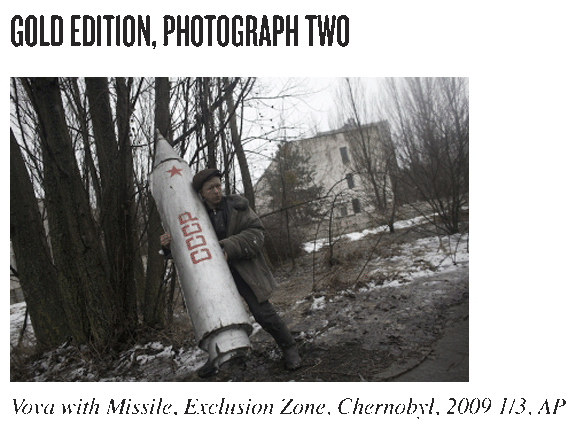
Weber will be selling a number of collector’s editions to help support the publication of the book. Buying at Bronze edition at $200 will get you a 8×10 signed print and a signed specially packaged edition of the book. The Gold Edition, at $1000, gets you the choice of one of five 30×40 prints (each an edition of 3 Artist’s Proofs) plus the signed packaged book.
You can get more information and order the special editions here.
‘
Losing Kodachrome and Letraset
January 1, 2011 | Filed Under Blog, From the Newspapers | Leave a Comment
The various stories this past week about the end of Kodachrome reminded me of a couple of articles I came across on Derek Beaulieu’s blog. Beaulieu is a Calgary based artist, a bit of a Renaissance man, a poet and artist, arts organizer etc,. Derek had been using Letraset to create text based works of art but has run into the problem of finding Letraset sheets. In case you don’t remember Letraset sheets contained letters (and more) that you would rub to transfer to another surface. They were used heavily by the graphic, design and publishing industries but have been replaced by more modern technology. Beaulieu tells a story of going to the store he usually bought the sheets from only to be told they’d thrown them out as nobody was buying them anymore leaving him without a favourite tool. You can read a story about it at The Weal or see a short film of Derek creating one of his Letraset artworks on a window in Calgary’s Pages book store.
To get you started on New Years day how about the pictures of the day from the NY Times Lens blog with images of New Year celebrations around the globe. You can also take a look at John Galayda’s photos of a burlesque show Kitty Nights from the NY Times East Village blog. A reminder of low light and black and white.
Need some incentive to get out with your camera for the New Year, why not try a little street photography? You can follow the enigmatic instructions posted at Street Photography Now to get a little inspiration. Assignment #14 posted Dec. 31 is Show Us The Aftermath. Sarah Bakewell mentions the project in an article on street photography in the Guardian.
From the Washington Post – Banker Andrew Plara became fascinated by documentary photography and became a collector, a collection that has now become part of a private museum ‘Pier 24′ in San Francisco. Story here.
Don Denton is a photographer, photo editor and photo coach who lives in Victoria, British Columbia.