Interview – T. Reilly Hodgson
February 20, 2011 | Filed Under Interview | Leave a Comment
1. Give us a brief bio of T. Reilly Hodgson and tell us what the T stands for.
I was born in 1987 in the suburbs of Toronto. I’ve gone to school at Emily Carr University in Vancouver for fine arts/ printmaking and OCAD University in Toronto for photography. The T is for Thomas but I don’t use that name.
2. How did your fine art schooling affect your work? Would you recommend that route to someone else wanting to become a fine art photographer?
I think art school has taught me to try to slow down and be a bit more patient with my work, which has been a good thing. Otherwise, I’m still on the fence about it. I’ve gone to and left two of the more esteemed art schools in the country for two different programs and found that neither of them really left me feeling very satisfied. If you’re talented and truly passionate about your craft I don’t think its essential. You’ve really got to want to be there considering the amount of money it costs to go and right now I’m getting more done out of University than I was when I was stuck in classes writing papers.
3. Your photographs seem to be about your personal world. How do you classify yourself as a photographer (documentary, art) or do you?
My majority of my photos are candid shots from my every day type of life, its true, though I’m not sure exactly if I could classify myself like that at this point. There’s an element of documentary in a large amount of my work but there’s a lot more to it than that for me. I do want to make pictures that are artful, that’s for sure, but I’m also interested in the way that memory works. I use photos to express something in the same way I might use a drawing or painting to express something, but at the same time, I know that if I end up with kids in 20 years these photos are going to be how they learn about me, the same way I learned about my family pouring through boxes of their old photos. That’s a pretty fucked up thing to think about. I can’t do that with a drawing. I’ve got to one-up shots of building the CN railway west across Canada, guarding the King in England, commanding tanks in WWII, and racing horses in the 50s and 60s. Its all the same story.
4. Can you describe what you’re trying to do/show when you photograph?
What I am trying to do when I photograph can change when my subjects change, but to be honest, it’s a sort of selfish pursuit.
5. You’ve created a number of zines featuring your work. What appeals to you as a photographer about these small magazines? How do you create them?
Zines are a really nice and inexpensive way for me to share my photographs with other people, friends, magazines, curators, art directors, etc. I like self publishing because of the total freedom I have with my work. Since I shoot film the few dollars I make from them also helps pay for that. How I go about making a zine depends on what the project is, but I try to do as much of the work myself as possible. I do all of the design and layouts myself, either print them at home or a local print shop, and get into a studio wherever I can if there is any extra silkscreen or letterpress work involved.
6. You were recently involved in a group show in Toronto, what was that experience like? Were you involved in organizing it?
I assume you’re talking about the Born Into This exhibition. I had a really great time doing that show! The people from The Cheaper Show and Scion gave me a grant to curate an exhibition with my good friend Dimitri Karakostas. We put together work by some of our favorite photographer and artist pals from Toronto as well as pieces by people with ties to the city who we really admire. It all came together pretty nicely and we opened to a full house, I think everyone was happy about how it turned out except the gallery’s landlord. We painted the walls with a pesticide sprayer.
7. On your blog(s) you often feature other zines sent to you. Can you talk about the photo zine community, or at least how you are involved in it?
I got into zines when I was in the 6th grade. I was aware of punk rock and skateboard fanzines through going to local shows, but I was really captured by the stuff I could get through the mail. I was ecstatic about graffiti when I was a kid, and even though the internet was around, at that point everything was all message board based so if you wanted to see anything really cool you’d try to hook up picure and zine trades with people in other cities. Especially living in the suburbs, they were the only way into those subcultures. Youtube didn’t exist, Banksy didn’t exist, and Nike wasn’t paying writers for logos yet. Now days everyone is connected and it seems like everyone is a “photographer” and everyone has a zine. I post zines on my blogs both to help my friends’ sell their stuff and also to share some of the things that are printed in limited runs. Thousands of people can look at a zine online even if the 50 physical copies of it have sold out.
8. You also seem to use Flickr a great deal and many of your online links lead to other photographers’ Flickr pages. Some photographers seem to dislike Flickr but you embrace it, why?
I think a lot of photographers don’t like flickr because they’re afraid someone is going to steal their work. The reality is that 98% of what is on Flickr is garbage, some of my work included, and the chances of someone being able to profit off of your tiny 72dpi image is slim. You are not a master, people probably don’t even want to look at your pictures, let alone steal them. All that said, Flickr and sites like it are a tool and there is a very large audience there if you know how to use them. I’ve been published a few times based on the fact that someone saw the pictures on my flickr account and got in touch. The pros outweigh the cons, if you ask me. People take the internet too seriously.
9. What will you be photographing next?
One of my teenage friends got a poisonous snake recently, so probably something with him. I just watched a video about those pastors in the states who handle rattlesnakes because they think that the power of god protects them, that kind of stuff is ridiculous.
10. You seem, at the very least, ambivalent about life in the suburbs. How does that show up in your work?
I think that’s a good word for it. On one hand, I’m living at my parents’ nice house in a safe neighborhood with a nice dog and we get along and that’s all great, but on the other hand I’m stuck in a town that’s designed so that nothing interesting ever happens. There’s nothing much to do if you’re young and don’t play sports and so you end up with huge groups of kids who just want to drink and deal drugs and vandalize and steal cars. I grew up hanging out around the train tracks and going to shows with skate punks, so I guess I got the best of both worlds. There’s a really fine line between youthful rebellion, suburban excess and kids on the edge of nihilism and I think that’s what I am interested in.
11. Do you think you may move from producing zines to producing larger books?
I’m definitely interested in doing books in the future. It’s something I’ve always thought about, I’m just waiting for the right project to fall into my lap at the same time as the budget to make it happen.
12. Finally the big question, where do you hope your photography will take you?
Out of my parents’ house.
You can check out more of T. Reilly Hodgson’s work here.
Lauren Henkin – Interview
February 13, 2011 | Filed Under Interview, Photo Book | Leave a Comment
1: You came to photography as career fairly recently. What made you or how did you come to make that decision to become a photographer?
I started photographing in college actually, which was 15 years ago. We had a very small darkroom in the architecture school where I was studying and I was lucky enough to be able to work one-on-one with an architectural photographer, who taught me quite a bit in a short amount of time.
I’ve been committed to building portfolios of work for about 6 years. It started after seeing a retrospective of Harry Callahan’s work at the National Gallery of Art in Washington, DC. I knew, when I saw his prints, that I wanted to dedicate myself to being able to print and photograph at the high standard that he was. From there, I started taking intensive workshops and reading whatever I could find to hone my technical abilities.
2: How would you describe your photography?
I would describe it as stories that build slowly, where one image leads to the next and an understanding comes at the end, when some conclusion is made. I tend to work from the inside out, using photography as a way to communicate what my fears are, what my hopes are, what I long for.
3: You use film, why?
I use film for two reasons. The first is because it gives me the best quality files to be able to print from. I have not experienced a digital camera that can give me the range of light that film can. The second is habit. I have my process down, I’m comfortable with it, it’s what works for me.
4. How do you print, digitally or traditional wet darkroom and why?
I print digitally because I have the most control that way over my prints. I used to be a darkroom printer and I’ve also tried platinum, but I like, for example, to be able to control localized contrast and sharpening, both of which are problematic in traditional wet darkroom printing.
5: You’ve created two books of your photography. Self published photo books are extremely popular right now but yours are different in that they are very high quality. Most photographers are printing lower quality/priced volumes. Why did you decide to go a higher end project?
I decided to make handmade books filled with original prints because I haven’t found a print on demand option that can produce the level of printing that I like to present my work. Print on demand books are also quite expensive to produce, not that much less than what it costs to produce my handmade books. I think they are perfect for many photographers, it’s just not the kind of presentation I’m interested in for my work.
6: What were some of the challenges you faced in producing your books?
The downside to producing handmade books is the amount of effort, time and upfront costs associated. There are more options to consider, what paper, what binding, what edition size that go into the process. Hand-printing an edition of 60 books with 39 images in the book is a huge undertaking, and I’ve learned, as I’ve gone through it, how to get better at managing my time, but it’s still a huge process.
7: You’ve had numerous gallery exhibitions of your work. How do you see the difference between the ‘gallery’ of a book and images hung on a wall?
The biggest difference is the ability for the artist to control the viewing experience more. Usually, with images hung on a wall, people move to look at images that interest them, they can skip images, or move out of the order the artist intends. With a book, beyond just controlling that viewing experience, you can go beyond just the sense of sight and incorporate touch, sound, text, and other means of telling your story more carefully as well. In addition, a book is a personal experience, it is something usually done alone, and is portable also.
8. You live in Portland, Oregon which does have a reputation as an artist friendly city. Would you agree? What is the attraction for a photographer?
It’s definitely an artist friendly city. There is a large artist population, not just limited to photographers. There are large printmaking, book arts, and graphic arts communities as well. The attraction is to be surrounded by other photographers that are working artists, not just hobbyists, and to also have galleries importing good works to show as well. The point is keep pushing forward, and part of that is being exposed to other good work.
9: You’ve photographed in Nova Scotia and are currently doing work on Salt Spring Island. What;s the attraction of Canada?
There wasn’t an attraction to Canada per se, although Canadians do seem more open to me freely trespassing on their property! I went to both places because they looked like beautiful places to go and photograph, not because they were in Canada. I should say that Canadians have treated me wonderfully, and I’d like to do more work there.
10. You have a site, Photo Radio, where you offer sound only interviews with photographers. In these days of YouTube, why radio rather than video?
I don’t know the first thing about video. And frankly, it seems pretty intimidating to me. I’m not sure what you would get from video that you can’t get from audio. I also prefer stripping away the visual at times and just focusing on someone’s words and thoughts, I think it puts everyone on a level playing field.
11. You offer workshops in marketing yourself as an artist. What is the attraction for you of teaching a workshop?
The attraction is being able to share what I have learned in the hopes that the information or experiences that I have will be useful to others. There are so many aspects to being a successful artist, I have always been as open as I can in sharing what knowledge I have with others, I would hope for more of that actually from the entire community.
12. What are your top three tips for anyone wanting to become a fine art photographer?
I only get three? I can’t do less than four!
1- Hone your craft. If you don’t have the foundation to craft good photographs and prints, you’re going to be leaping way ahead of yourself and eventually, you’ll have to come back, so might as well learn to take good pictures and make beautiful prints from the start.
2- Make connections. The biggest part of gaining an audience for your work is through making connections with anyone associated in fine art photographer, whether that be other artists, or curators, or even writers. You never know how someone can help you or your career, so talk to lots and lots of people.
3- Develop a thick skin. There is so much rejection involved with trying to get your work out there, that if you’re sensitive, it will be a problem. I have been rejected so many times I’ve stopped counting, and even though I know it could have very little to do with me or my work, it’s still tough to swallow sometimes.
4- Give back. No matter how much or how little success you experience, you should always try to give back to the community, to nurture younger photographer, to educate, and to encourage sharing, acts that benefit us all.
Lauren Henkin’s site is HERE.
Artist Rachel Berman – New Project Featuring Environmental Portraits
February 12, 2011 | Filed Under Arts, Personal Project, Portrait | 2 Comments
Every year I like to start at least one new project. I like to have a number of projects going at the once as I find that due to my full time shooting job my time for personal shooting is limited in both hours and time of day. Having a number of projects means I can usually shoot something in the windows that I have.
So, this year, adding to the mix is a series of environmental portraits of artists. I’ve done a large project featuring images of writers but hadn’t really worked on that much in the past couple of years. I wanted to introduce a new portrait project and figured focusing in on visual artists would be both interesting and challenging and would also have the side benefit of not only meeting new people but I’d get to see a lot of art.
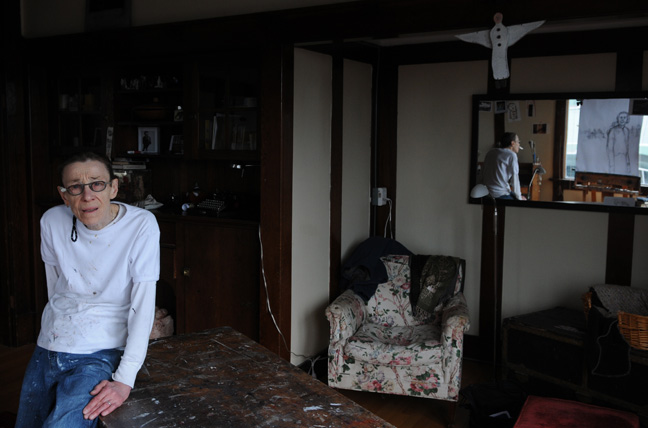
I’ve started off with artist Rachel Berman who is local again after a couple of years in Toronto. I’d never met her before the session but had admired her work so called her up, explained what I was doing and we set up a time to meet.
Rachel works out of her apartment studio, a great place in an older building with bay windows that let in a ton of light. She was busy working on two projects, illustrations for a book and a show at her Toronto gallery.
A bonus at this shoot was the presence of Karl Spreitz, a long time local artist, photographer and member of the Limners, a long time Canadian art collective. It was my first time meeting Karl as well and I took the opportunity to enquire about photographing him at some point. Karl, as mentioned, is a stills photographer as well as a documentary filmmaker and he was busy shooting and filming during part of my portrait session.
I spent about an hour with Rachel, taking photographs, but also chatting and getting to know each other a bit.
I took Rachel a couple of prints last week and she seemed pleased with the images. It was, from my viewpoint, a successful shoot, I had a few frames I’m happy with. I got to meet two new creative people and I’ve got another project underway.
Rachel is represented by the Ingram Gallery in Toronto and Granville Fine Art in Vancouver. Toronto artist Sara Sniderhan has painted a portrait of Rachel that you can see HERE.
Daniel Milnor – Smogranch
February 3, 2011 | Filed Under Blog | 3 Comments
I haven’t been posting a great deal here. That said I have been checking out a few other blogs. One that I’ve spent quite a bit of time on the past week is Daniel Milnor’s Smogranch. I’d never run across Milnor until a week ago so it’s all a pleasant surprise. I enjoy Milnor’s writing and his images are amazing. It’s oddly nice to see someone shooting film. He’s a book making machine and there’s lessons there for all of us in presenting/promoting our work. I’m slowly making my way through his archives learning about Milnor’s work and life. His latest post tells about his decision to give up all commercial work and concentrate on his personal work. He doesn’t explain how he’ll replace his commercial income but maybe that’ll be in a post to come. Here’s a bit from that post that captures some of Milnor’s style: ”As many of you know, on December 1st I stopped shooting commercially. No mas. No portraits, weddings, magazine work, commercial shoots, etc. I needed a new direction, and so far the grand experiment has been enlightening, making me think I should have done this ten years ago. However, it’s not enough, just stopping the work for others focusing only on the work for me. Within this shift lies another, smaller, but I’m realizing perhaps more important, micro shift. The direction of the work. And when I say direction I mean the content, the style in which it is created and the method of presentation”. His post on the documentary life is certainly worth a read as well but you need the whole piece, an excerpt won’t do. Read it here.
Don Denton is a photographer, photo editor and photo coach who lives in Victoria, British Columbia.