Vancouver Island Ships

June 1, 2011 | Filed Under Photography, Photojournalism | Leave a Comment 

A lighthouse, small naval ship and a fully loaded container carrying freighter heading towards the open Pacific Ocean. Just another Vancouver Island seascape.


Photographer Wilf Schmidt Loses Battle With Cancer

May 5, 2011 | Filed Under Obituary, Photography | Leave a Comment 

One of the more popular posts I’d done was about retired Kamloops photo teacher and photographer Wilf Schmidt who was operating a tiny photography gallery in the Interior city.

I hadn’t been through Kamloops since last summer and that time was a quick stop so didn’t get to drop by the gallery. We were finally heading up that way again this past weekend and on Thursday I opened my email to drop Wilf a note to see if he’d be open on the Monday and there was a link to Rachel Anastasia’s blog I Heart Rachabees and a posting that Wilf had passed away a few days earlier. I knew Wilf had been battling cancer but we never really expect people to lose that battle I guess.

I can’t say that I knew Wilf that well but I’d known him for a long time as I started my newspaper photography career in Kamloops thirty plus years ago. It’s not that big a place and you get to meet most people with similiar interests.

Sunday I wandered downtown and checked out Wilf’s gallery. Closed of course but with a sign announcing a memorial service for him this coming Saturday. I won’t make it so this posting will be my small memorial.


The Ramones and The Avengers in Vancouver

April 6, 2011 | Filed Under Music, Photography, Vancouver Punk | Leave a Comment 

I have a new show of my early Vancouver punk photos opening at the Talk Is Cheap Gallery on Pandora Street in Victoria this coming Saturday. I’ve been sorting through my negs yet again and had a couple news ones scanned. It’s interesting what I keep finding.

I came across this group shot of the Ramones posing for me before their gig at the Commodore.  I did notice the guy standing at left looking on but just figured he was a roadie or something and I’d just crop him out. However after seeing the scan I’m pretty certain that’s  it’s Gerry Hannah from the Subhumans.

This is The Avengers, with Penelope Houston at right. I photographed them twice when they played in Vancouver.


West Coast Winter

March 2, 2011 | Filed Under Photography, Photojournalism | Leave a Comment 

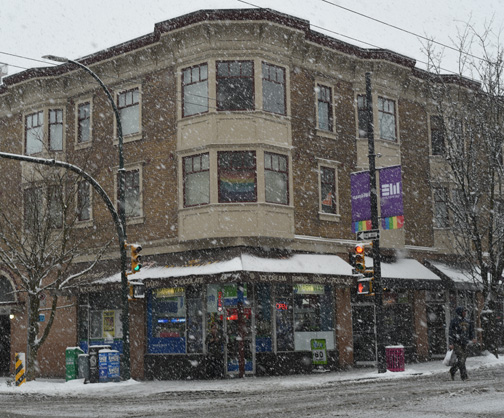
So here’s photographic proof we do get winter out here open the western edge of the world. Sure, it did only last three days but it was a hard three days.


TJ Watt – Interview

January 11, 2011 | Filed Under Interview, Photography | 3 Comments 

1) Who is TJ Watt?

Born, raised, and living in beautiful Metchosin, BC, he is on a quest to protect BC’s world class ancient forests through visual media and public outreach. He spends his free time skateboarding, climbing trees, dancing through the night, and staring curiously at the stars.

2) I think it’s safe to say your photography is mainly related to your interest in environmental protection. Can you explain why?

Well it seems to have evolved naturally in that direction over the past few years. It’s basically a melding of my interest in landscape photography with my strong passion for conservation work and exploring the wilderness of BC. Instead of just taking pretty pictures I started to see it would be much more valuable if they served a higher purpose at the same time. Photography is a very powerful tool for raising environmental awareness in many ways but I think one of the most critical points is its ability to bring very remote or hidden places to the public’s eye. My work focus’s mainly on the threats to BC’s endangered old-growth forests and often times I am taking photos where less than and a handful of people have been if any at all. The dense rainforest’s of Vancouver Island are largely unexplored so it’s amazing to share images from these virtually unknown places. If you can’t bring the 4 million plus citizens of British Columbia to the woods then you need to bring the woods to them and now, with the power of GPS mapping and Google Earth, you can extend that concept to the entire world.


3) You’ve actually, with a couple of others, started your own environmental group. What is the focus of that group and how did it start?

At the start of 2010, Ken Wu, the former Campaign Director for the Western Canada Wilderness Committee along with myself and a few other activists launched a new ENGO called the Ancient Forest Alliance. In our first year we have become the fastest growing environmental group in Canada with nearly 20,000 supporters joining on with us. The organization’s goal is to be the driving force in the fight to protect BC’s endangered ancient forests and forestry jobs. We’re pushing to see old-growth forests protected where they are scarce such as Vancouver Island and the Southern Mainland, a transition to sustainable second-growth logging instead, a ban on raw log exports, and the creation of more value added wood manufacturing facilities. Our group differs as well in that we chose not to have charitable status which allows us to be much more political. We are exercising that power in one way by helping start Ancient Forest Committees that will work in key provincial swing ridings to put pressure on politicians around their forest policies. You can find us on Facebook, on Twitter, and at www.ancientforestalliance.org  Don’t forget to sign the petition as well at www.ancientforestpetition.com !


4) You work in some fairly difficult terrain and the west coast forests can be both wet and dark. What are some of your photography challenges?

That is true! As beautiful and enchanting as the temperate rainforest is, it has its many photographic challenges. The first and foremost struggle is just moving through it. Next time you’re on a boardwalk in Carmanah Provincial Park or the rainforest trail in Tofino, take a look off to the side and imagine bush whacking through the under story while carrying 30 pounds of gear with you. The forest can be incredibly dense with 6ft tall salal bushes, sharp branches poking your eyes, steep slippery cliffs, sinkholes, and not to mention giant fallen trees that even on their side can be twice as tall as you and over 200ft long. It’s perfect leg breaking territory. The second test is found in the name rainforest itself. Rain! Lots of it! Trying to keep yourself and your expensive gear dry is at times impossible and makes changing lenses, batteries, and memory cards a scary task. The last challenge might sound off but it is the sun. It seems strange to complain about it after whining about the rain but it can be just as frustrating. The patchwork of openings in the forest canopy causes the light to be very mottled on the forest floor. The contrast from light to dark is often times too wide a range for the camera and makes for a very distracting scene. The ideal day is overcast with the sun just about shining through right after a light rain shower which gets everything rich in color.
Oh, and a tripod is a must too!

5) Your work is about the west coast landscape, are there any other areas in the world you’d like to photograph?

To be honest, I am quite obsessed with the forests of BC and could be happy taking photos here forever but if I had to choose some other places I might say somewhere like Iceland. I love its dramatic and desolate landscapes, giant mountains, and exploding volcanoes. It almost appears from another planet. Recently I was down in Argentina and Chile and crossing the Andes was an incredible experience. It’s like getting a trip through canyons on Mars. The red, yellow, and black color of the soil in contrast with ice blue glacial lakes was just spectacular. I would also find it fascinating to photograph in abandoned urban areas that are slowly decaying and being reclaimed by nature. It’s a great reminder of our own impermanence.

6)  Are there other photographers whose photography is centered around protection of the natural environment that you admire?

Most definitely. In this province the work of people like Garth Lenz and Ian McAllister really stand out. Garth has documented BC’s rainforests and the effects of industrial forestry for nearly two decades and has more recently focused his aerial photography on the Alberta tar sands. It was exciting to have him as a teacher at Western Academy of Photography and I was happy to hear he was recently accepted into the International League of Conservation Photographers. Ian works with a group called Pacific Wild and has done an absolutely stunning job of photographing the wildlife in the Great Bear Rainforest on BC’s coast. His shots of wolves and grizzlies are breathtaking and have helped tremendously in raising awareness about the complexity and fragility of that areas ecosystems.

7) Do you do any other photography to supplement your environmental work?

In the sense of weddings or advertising, etc, no. It doesn’t really work for me. If I can find a way to make a personal connection with a project, even if it’s out of my usual field, I may try to take it on. It can be a fun new challenge stepping out of the norm for awhile but I mostly stick to my main focus.
I find that most of my interesting new experiences come from the combination of my environmental campaign work and my own photography leading to opportunities I may have otherwise missed. With the power of the internet people from all over the world can stumble upon your images and next thing you know you’re on to something new as well.

8) Most photographers have personal projects. You photograph abandoned mattresses. Tell us about that?

Haha, yes. I have a thing for abandoned places and objects. The collecting of mattress photos started while I was living in Toronto for a year and one day noticed just how many were strewn about the streets and alley ways. It was like they had been invisible before I became aware of them and then they were just everywhere. I think what I find most interesting about them is that you never see anyone in the actual process of abandoning one. You will be driving down a rural road somewhere and there will just be one looking shiny and new leaning up against and old rotting fence. Or there will be one out alone in the middle of a soccer field with the spotlights shining eerily on it at night as if it just teleported there. Even though I am sure people dump them in a hurried or careless way, each one ends up taking on its own unique aesthetic as to how it fits into the scene. And then they just disappear.

9) You also buy old cameras from thrift shops and process any film found inside. Why?

I haven’t done this in awhile but it sure is fun. I find it odd that people could leave film inside a camera and toss it away with their pictures inside it. Maybe they forgot or just didn’t care but for me it becomes a surprise peek into another world. It’s really like reaching into a stocking on Christmas because you just don’t know what you’ll pull out. I have found some pretty funny photos in the rolls. I’m sure many of them seem funny though only because you don’t have any context for the scenes you’re looking at. You find some beautiful ones too like this one roll of old expired disc film that had someone’s travel pictures on it. There were these lovely scenes of fields with rainbows, giant mountains, and old buildings mixed with all the distorted colors from the old film. It would be great to put a collection of them together for a show.

10) What will 2011 bring for TJ Watt?

That’s an exciting thought! I’m really hoping it brings plenty of adventure and opportunities to work with more new and interesting people doing progressive things. 2010 was the most exciting year of photography for me so far as working with the Ancient Forest Alliance has finally allowed me to really focus on what I love instead of doing random jobs and trying to run out into the woods on weekends. We have plans to undertake many more expeditions into the valleys and forests of the mid and north of Vancouver Island. There really is so much more to be explored out there. A couple of books should be in the works as well along with the startup of a new eco-tourism based business I am working on. Keep your eyes peeled!

You can see more of TJ Watt’s work here.


Self Portraits

November 29, 2010 | Filed Under Photography, Portrait, Self portrait | Leave a Comment 

I’m a sucker for self-portraits. I like taking them and I like looking at them so I had to take a peek when I saw the Globe and  Mail was running a Share Your Self Portrait page. I kind of like the smily face finger image. If you really want to want to spend some time looking at self-portraits check out the many pages of images in the Flickr self portrait pool. You can see some pro photographer’s self portraits here at Listicles, not to mention other weird stuff. Google will supply you with nearly 6000 self portraits although not all are photography. Gizmodo has some pretty cool examples from the 168 readers who sent in images. Wikipedia will give you all the history and background you need on self portraits. Wikipedia also told me that Bob Dylan made an album called Self Portrait. If you want to get kind of creeped out, look at these photoshopped self portraits at Speckyboy. Last, and as always, certainly not least quickly check out the 638 Magnum photographers’ self portraits.


Mike Drew – Interview

November 28, 2010 | Filed Under Interview, Photography | 3 Comments 

1) You are unusual among newspaper photographers in that you have your own weekly column. Describe what your column is about.

Basically, I go and have an adventure and write about it. The adventure can be anything I feel like doing. Most of the time I poke around southern Alberta – the best place in the world – but I also write about my trips to other places as well. I’ve done stories from every continent except Australia and Antarctica but I expect to knock those two off pretty soon.
Most of the time i just pick a direction and go. My natural tendency is to head east and south because those wide open, unpopulated, treeless lands are what I prefer to explore. The mountains are okay, too, but they just don’t speak to me like the prairies do. I photograph the land, the sky, the plants and animals and absorb the ambiance of wherever I am. I’m not often around other people when I’m at these places but I don’t try to avoid them. I like chatting with folks and quite often those visits get mentioned in my yarns but most of the time I have the world to myself.
All of this is done on my own time, on my days off from my regular newspaper job.

2) How long have you been producing the column?

I started doing these stories in 1991 so I’m coming up on 20 years. At first I travelled everywhere with my dog Ansey and it was him who made the stories popular. In the pre-internet days we got mail from as far off as Saudi Arabia and Australia from people who had the clippings sent to them by friends in Alberta. Ansey and I rode the rails together for nearly 16 years but since he ran ahead up the trail back in 1997 I’ve been rolling solo. I miss him every day and I still keep his bandana hanging from my rearview mirror. He will always be with me.

4) Describe a typical day out for the column.

My favorite time of day is the early morning so I’m often up at around 4 a.m. in the summer to make sure i’m somewhere interesting when the sun pops above the horizon. I’ll look for birds and animals and stop to shoot whatever catches my eye. These days I shoot video along with still photos so I look for situations will work as video clips as well. I thoroughly enjoy the video aspect. It adds a whole other dimension. Come wintertime I’ll go wherever the weather takes me. On a cold, sunny day I’ll head to the grasslands. if it’s snowing I’ll swing through the foothills or hit the mountains. A typical day any time of year runs about 12 hours, most of it spent driving with a couple of hours of walking thrown in. When I’m writing about a fishing trip it might be the opposite with just a couple of hours driving and more time spent walking.
Most days, though I just cruise and keep my eyes open. I always see something and every time it’s something new.

5) You do a lot of driving for the column, what sort of mileage do you accumulate in a year?

I average about 400 km per trip but I’ve had several days where I’ve driven 1000 km or more. Last year I took off to New Mexico and drove over 6000 km in six days. I drive a 2007 Toyota FJ Cruiser that’s just about to hit 250,000 km.

6) Do you carry a lot of photo gear with you or do you travel light?

I always pack at least two cameras which these days are Canons that shoot both still and video. On one is a big-ass Sigma 50-500 and the other usually has a wide-angle zoom. When I hike around I pack a carbon-fibre tripod with a video head, a microphone, extension tubes and a hand-held audio recorder. I always have a flash with me but I rarely use it. When I’m shooting to please myself I have the luxury of looking for good light. When I’m shooting for the paper I often have to use the flash to make up for the lack of good light.

7) What is it about Southern Alberta that continues to fascinate you?

Here’s my favorite example of why Southern Alberta is so awesome. The Bow River runs from the Rockies down through the foothills. It bisects Calgary before heading out onto the plains where it meets the Oldman River to form the South Saskatchewan River. For its first third its a tumbling mountain stream. The middle is one of the best trout streams in the world. And the lower stretch is a wide, warm, slow-moving prairie river.
In the space of a single day you can photograph mountain goats, bighorn sheep and grizzlies at the base of a glacier, catch and release trout as long as your arm right in the middle of a city of a million people and poke around sagebrush flats photographing cactus, rattlesnakes and scorpions and never be more than a quarter-mile away from that one ribbon of bright water. I don’t think you can do that anywhere else in the world.
And that’s just one watershed. the Red Deer River cuts through the badlands and exposes massive dinosaur graveyards, the Milk River has sandstone cliffs covered with petroglyphs and is the farthest north branch of the Mississippi. You can paddle a canoe from the town of Milk River all the way to New Orleans. The Rockies run along the B.C. border and no one has to tell you how spectacular they are. But the sand dunes and near-desert country along the eastern border are every bit as amazing.
Then there’s the Milk River canyon where you can find yucca blooming and watch elk and antelope mingle on the sagebrush-studded plains.  Over by Waterton there’s sandhill cranes nesting on the same ponds that trumpeter swans raise their young. Drive up into the Porcupine Hills and see Head-Smashed-In Buffalo Jump, a World Heritage site, and continue on into the best ranching country in the world. Find the shade of a cottonwood tree to get yourself out of the 40C summer heat over by Medicine Hat and pack survival gear for a winter drive drive west of Caroline in minus-40C cold. Or wait a couple of days for a chinook that you can smell as it blows in across the mountains and watch the temperature rise 20 degrees in the space of a few hours. God, I love this country!

8) Is there one area of southern Alberta in particular that you enjoy more than another?

I far prefer the plains to the mountains but there are places in both that draw me back. In the mountains there’s the upper Oldman River valley – great cutthroat trout fishing – and Smith-Dorrien Trail that runs up the Spray River behind Canmore. And Waterton, of course, that gorgeous gem of a forgotten national park that sits in the southwest corner of the province. Almost no one goes there and that’s all right with me. The Porcupine Hills south of Calgary should be a national park run entirely by ranchers. I enjoy the wild horse country west of Sundre and on up to Ya-Ha-Tinda.
On the prairies, well, I like pretty much everywhere. The top spots would be Dry Island Buffalo Jump, the north side of Dinosaur Provincial Park, the Red Deer River valley from Jenner down to Empress and the Saskatchewan border, the Milk River Ridge, the Pinhorn Grazing Range and the Milk River canyon, the Cypress Hills – especially the south-facing slopes – and the irrigation lands between Lethbridge and Medicine Hat. Gotta give some love to the parkland country, too, up around Stettler and Buffalo Lake and on east from there.

9) You have a close connection with your readers who seem to relate very personally with your columns. Can you talk about that?

I can’t tell you how much I enjoy people coming up to me and introducing themselves. It’s just so cool to know that there are folks out there who get a little joy out of what I do. Not to sound too cynical but when you work in the news business you tend to pay far more attention to all the worst parts of humanity. You cover far more deaths than births, you rush to a house burning down and forget the ones being built. You shoot millionaires playing games and pass right by the working poor on your way to do it.
So when someone seeks you out to shake your hand or takes the time to write you an email or send you a card, well, it’s like taking a deep breath of prairie air after a thunderstorm has passed. Every time it happens I know that I have been blessed.

10) You are out in about in all manner of weather. You drive through areas that are sometimes remote and/or isolated.  Have you ever had a negative experience as a result of weather conditions or human/wildlife confrontations?

I have done many stupid things while adventuring around. I got struck on the hand by a rattlesnake because I got too close with my camera – it didn’t bite, fortunately – and came mighty close to running out of gas in the middle of Nevada trying to follow a Pony Express trail. I’ve fallen into numerous creeks and rivers – cameras and all – and driven fish hooks into both hands, both arms, my back and nailed my hat to my head a half-dozen times trying to cast heavy flies on windy days. Fishing in Argentina I drove a hook into the end of my nose.
But the worst was getting lost among the steep coulees that run down into the Milk River Canyon. I’d spent the night out on the prairie and lit out first thing in the morning to hike down to the river about 600 feet below on the canyon floor. i followed a coulee down to the river and then hiked upstream thinking I’d just find another coulee and walk back up to the truck. I left my water jug behind thinking I’d only be gone for maybe an hour.
Nine hours later I still hadn’t found the truck. I’d forgotten that the coulees weren’t running in straight lines and the one I’d picked followed a long curve that took me way past where I thought I was. The temperature out in the sun was pushing 40C. There was no shade and I had no water. My vision was starting to tunnel and I was thinking very seriously of just lying down and going to sleep. The nearest human habitation was more than a 30 km walk away and I had just sat down on a rock to try to think about what to do next when a glint about a quarter mile off caught my eye. It was my truck and in my delirium I’d walked right past it. I staggered over, opened the door and grabbed the water jug but my throat was so dry I couldn’t swallow. I let the water sit in my mouth until my throat opened up and when that first swallow hit my stomach every pore opened up on my body and I was suddenly drenched with sweat. I was so dehydrated that my systems were shutting down and I hadn’t even realized that up until then I hadn’t been sweating despite the heat. A rough lesson to learn but I got lucky. I’ll never let that happen again.

11) You shoot video now, as part of the online presentation of the column. How has that affected the way you work?

Shooting video has changed quite a lot of things, the biggest being that about all you use from your stills background is framing. All the rest is different. For example, say you’re shooting a story on a toy maker. For stills you shoot all the standard stuff – the tools, the hands, the parts being put together, the finished product. But for video you shoot ten seconds of the hands, ten seconds of the tools, ten seconds multiplied by as many angles as you can think of of the toys being assembled and various angles at ten seconds each of the finished project. Then you have the interview with the toymaker, maybe something of kids with the toys. And all of this has to be framed properly in a horizontal format. There’s no vertical in video and cropping options are limited.
Basically, video is a whole separate job from the stills.
When I do my On The Road stuff, though, I kind of have the opposite problem. Because wildlife opportunities are generally quite fleeting, I concentrate on video first and hope for stills. Yeah, video has changed my workflow a lot. But it has made me more aware of the visual opportunities all around me.

12) Do you have any plans for a book based on the columns?

I’d sure love to do one but I don’t have the slightest idea of how to get it done. So no, no plans but if I can figure out how it’s done I’ll go for it.

13) What else do you cover for the Calgary Sun? What have been some of the highlights of your ‘regular’ newspaper work?

I cover all the usual news and sports and shoot the things other news photographers shoot. Unlike most, though, I’m not a big sports fan. Sure, I like getting the peak moments and the story-telling photos of the games but really, I can take it or leave it. I’d really like to do more documentary photojournalism but newspapers don’t seem to be doing much of that any more. I had high hopes for a bright future in newspaper photography with the advent of the internet but no, so far it’s just more of the same. Editors are far better at finding ways to say no than to say yes. Thank God I have my column to do on my days off.
Having said that, though, I’ve done some pretty nifty things. The 1988 Winter Olympics were a lot of fun because there was so much more going on than just sports. There’s been some spectacular fires I’ve covered and it’s a blast driving around in a blizzard looking for pictures. And one time I was presented to the Queen.
But the best one was a trip to China to look at illegal immigration. The story was a bust but the pictures were great. It was a perfect lesson in how to get along in a foreign country. Just before we were about to leave an earthquake hit Taiwan and since we were close the reporter and I were sent to cover it. It was 48 hours of travel, shooting and sending photos over telephone lines – 45 minutes per picture! I remember watching the TV bounce across the cabinet and a picture swaying on the wall of the hotel room as the place shook with aftershocks.
The devastation was amazing but the people were so kind and unfailingly polite. Some day I want to go back there and see how everything has healed up.

You can follow Mike Drew’s adventures here


Grim Robes – Alexandre Lemire

November 23, 2010 | Filed Under Photo Book, Photography | Leave a Comment 

A very positive offshoot of the boom in the interest in photo books is that we’re not only seeing more professionally published volumes but we have so many independent publications available.

One of my daily stops on the internet trail is The Independent Photo Book site put together by Jorg Colberg and Hester Keijser which posts about books and zines published by photographers and/or very small presses.

One of the attractions of these books is their low cost. Granted the books may be tiny and some are produced in a very basic fashion but that’s part of their charm. It’s also easier to take a chance on a photographer’s work when you’re only handing over a few dollars.

The other day I checked in on Alexandre Lemire/Wolf Peterson’s Photo-Documentation from The Field site and I saw he had a new publication out called Motorcycle Grim Robes. I’ve bought a couple of Lemire’s zines before but this is a small (16 page) book or at least has heavier covers. I immediately hopped over to PayPal to purchase the publication.

This book intrigued me not only because I like Lemire’s work but because the photographs are of motorcycles draped in protective covers.

I’ve been working on a project myself which I’ve just been calling Wrapped with is a series of images of vehicles of all sorts wrapped in protective covers. I find that vehicles draped in fabric make interesting and ambiguous images.. Lemire seems to find it makes the vehicles more mysterious and threatening. I  think it’s interesting to compare image from series that focus on same subjects.

Here are a couple of photos from my series.


Luz Gallery – Quinton Gordon and Diana Millar

November 21, 2010 | Filed Under Gallery & Workshop, Interview, Photography | Leave a Comment 

Quinton Gordon and Diana Millar are the owners of the Luz Gallery.

1) Tell us about yourselves.

That’s a pretty open question but in short Diana and I have combined my background as a professional photographer, artist and instructor with Diana’s experience in event planning and business management. We are both originally from Ontario but we met here in Victoria four and a half years ago, and when our daughter Molly was born almost three years ago, we decided to try to make Victoria our home. That decision meant looking at some creative solutions to achieve our career aspirations.

2) Why start an art gallery that features photography?

For me the choice to focus on photography was easy, and for Diana it represented an exciting new challenge at a time when photography is really coming into it’s own within the international fine art market.

3) What was involved in creating the gallery?  How much research did you do before actually making the decision to move ahead with your idea?

Well, in many ways the research began 15 years ago with my first thoughts of creating a gallery and centre of photographic arts  during a five month period of travelling and photographing personal projects. Then in 2005 I was inspired by my experience at the Manuel Álvarez Bravo Centre for Photography in Oaxaca, Mexico and in 2008 we made the decision not to move back to Toronto and that sparked a decision to see if we could create Lúz. We spent a year developing our ideas and looking at the range of photographic galleries and centres of photography around North America, but it was also a case of just forging ahead to realize our combined vision.

4) You’re much more than a gallery. You offer workshops, custom printing, sell photo printers and photo papers.  Why do all that extra work? Wouldn’t it be easier to just concentrate on the gallery itself?

Easier yes that’s an understatement! We have a lot of balls in the air each day but even if we limited our endeavours to just the gallery it would still be a lot of work. There are two very compelling reasons to be more then just a photography gallery. The first is tied to our vision of building a stronger local and international photographic community, and the second is economic, the business would not be sustainable without several revenue streams, and even with those in place we are working in a community of just eighty thousand. There is no question that this would be easier if we have a larger population base.

Establishing a credible fine photographic gallery in the international market takes a long term vision of at least three to five years, and locally the buying market for photography is only just beginning to mature. In order to support a successful business model we had to balance the interests of both collectors of photography, with practitioners of photography by blending the exhibition and sale of fine photography with courses, seminars and quality retail services such as our digital print studio and the Tricera / Epson store.

5) Why do you think workshops are important?

We believe in the value of people learning and challenging themselves creatively and workshops are a great way to learn from a good instructor as well as from the other participants. This coming together of like minded people helps to reinforce the sense of community and we have seen how people who meet at our workshops continue to share ideas and communicate afterwards.

6) What has been the most important thing you’ve learned about running a gallery since you first opened?

That despite being a new gallery in an out of the way city, we can be part of a larger community and that like most successful businesses here we have to reach out to that larger community.

7) What advice would you give to a photographer wishing to have an exhibit with Luz?

This is a great question because we get people contacting us all the time and we want to encourage this, but it is helpful if they are well prepared.

Their starting point should be to read the submission guidelines published on our website. It is really hard when people just walk in off the street because as you pointed out earlier we are very busy running the various aspects of Lúz and as a general rule it is best if they introduce themselves by sending a submission package that includes their CV, a printed promotional piece, an artists statement and a carefully selected set of samples from the body of work they wish to show. Artists also need to realize that they need to develop a relationship with a gallery and that it takes time and effort to do so. The effort put in by an artist over time is part of the screening process. Rarely do things happen quickly for new artists. It can be different when we are approached by an established artist but even then we are planning well in advance.

We make a significant investment of time, money and energy when we mount an exhibition and it means that artists need to show us that they are serious about what they are doing and that they are making a significant investment in their work. Naturally it is important that we like their work and that we feel we can sell their work to our clients. It’s really helpful if they have published a book as well. Book sales are out pacing print sales and this can go some way to helping us recover the investment made in the exhibition.

Our exhibition calendar is scheduled roughly a year at a time and we try to balance juries shows with solo exhibitions of work by both established and emerging artists. We have 2011 basically nailed down now and we are looking to 2012. Now that we are going into our second and third years, the gallery has a growing international reputation and we are attracting established names from the US, Europe and Asia as well as across Canada so the competition for exhibition space is getting more challenging. We do want to support local artists and our juried exhibitions can be a great way for newer artists to start working with us. We are trying to put out at least one call each year for submissions to juried group shows and these shows are very helpful for artists to have on their CV.

8) Can you talk about the idea of the gallery as a community centre for photographers?

Here again you raise an important question. We are working hard to create a place where people can engage with photography through opportunities to see diverse work of a high calibre was well as a place to learn, and even a place to meet and connect with one another. As such it is significant that people understand that we don’t receive any government funding and that the cost of creating and delivering on what we offer is high. In order to keep our products and services affordable we set very tight margins on our pricing so if what we have created is valuable to the community then they need to support through purchases or even through donations made at our openings or events.

9) The gallery has led to some new opportunities for both of you. What are some of those opportunities?

Part of our motivation in opening Lúz was to be able to live here in Victoria while continuing to engage with the international photographic community. From the outset we have been focused on our belief that there is a place for Victoria in the international photography market and through Lúz we have been able to meet and collaborate with people such as Donald Weber, Stella Johnson or Joni Sternbach along with many others. It is also providing us with more travel opportunities as we add destination workshops in locations that interest us. Diana has been invited to be one of the portfolio reviewers at Photo Lucida in April 2011 and it is a huge honour for her to participate at this level, in effect she has been called up from the “farm team” to hit in the major league.

10) What trends are you noticing in photography being exhibited and offered for exhiibtions?

Well it depends on where you look, but for us the emphasis on contemporary photography challenges the divisions between documentary and fine art. Colour photography is playing a key role for many contemporary artists and for those working in B&W there is a lot of interest in fine traditional printing techniques.

11) What would be the dream exhibition you would each show?

One that sells out on opening night!

12) If price was no object what print would you each buy?

That’s tough, our list is pretty long, although (Quinton) I  have always wanted a print of Avedon’s or Cartier-Bresson. (Diana) I have an answer for a print I would buy – Harry Callahan, more like the collection – too hard to pick just one. Also the Yangtze project from Nadav Kandar has produced stunning images, that I would love to add to my collection.
The thing is that we work with and appreciate so many wonderful contemporary photographers that it would be an insurmountable challenge to select just one… I guess if money was no object we’d choose to support many artists and collect several works.

13) What do you see for the future of the gallery?

We work on our future every day, and frankly some days that means just figuring out how to keep it going. But aside from that it is a matter of getting to the point where we can consistently deliver the level of exhibitions, courses, and facilities we have in mind. We are adding more destination workshops and expanding our partnerships with other organizations such as Leica and Epson or festivals like Photo Lucida to facilitate growth. In terms of future expansion we would like to see this include more dedicated classroom space and a dedicated studio for teaching and rentals, a digital teaching lab and darkroom space. On the gallery front we are working to develop relationships with collectors so we can be more effective for the artists we represent.

We are also very motivated to increase our publishing ventures both online and in print and I am working toward launching Lúz Journal, a magazine of photography similar in concept to Dispatches or burn magazine founded by David Alan Harvey. We will initially publish online but I am a huge advocate of print and this remains my ultimate goal along with more publishing collaborations with our photographers to produce limited edition books.

We have ideas about introducing memberships or raising more funds through donations of money or equipment – of which we have received some already – but to do all of this we need to expand our human recourses and this is happening slowly with Dave Aharonian and Karen Iwachow coming onboard. Eventually we will work to expand our facilities but with the high price of real estate in Victoria it will take sometime to get there.Rright now we have our sights set on trying to pay next months rent.

You can check out the Luz Gallery’s exhibitions and workshops here. You can take a look at Quinton’s photography site here. You can listen to a recorded interview with Quinton by Portland photographer Lauren Henkin at her Photo Radio site here.


Della Rollins – Interview

November 19, 2010 | Filed Under Careers, Interview, Photography | Leave a Comment 

1) Photography is a second career for you. What advantage and/or disadvantage did that create for you?
I’ve actually found it quite to my advantage that I had a previous career in public relations.
My PR background gave me some solid skills that I have found to be quite useful, namely:
-    Networking:

I hate this term since it sounds so phony, but it really is important. In my previous career it became evident that there were people who were quite good at what they did. I would make every effort to get to know them and learn what I could from them.

In photography I was able to quickly size up the industry – who was who, who makes decisions, who is good at their job and is well respected – and then seek them out to meet them. That alone has helped a ton.

I’ve found that if you’re eager and willing to listen, people are more than happy to help.

-    Expectations:

I think I was pretty realistic about what to expect when starting a business. I knew it would take time, that I’d have to work hard and put in my time at the bottom and that the work ethic I had applied to my previous career would carry me through in this new job.

-    Marketing:

The basics of getting myself up-and-running were easier. I was familiar with invoicing (as I managed clients I knew what I liked/disliked in invoices I received). I know what clients expect from suppliers. I was not nervous about creating a business plan, how to find clients and how to keep clients happy. I knew how to sell myself.

-    Writing:

Some projects I picked up this year involved writing. I’m able to market myself as a writer and photographer, a skill that a lot of my clients appreciate.

-    Service:

Having worked on the client side of the business, managing suppliers (in PR) I knew how I wanted people to manage my account. I instinctively knew what newspapers and other clients were looking for in a photographer beyond just technical skills.

I took editors to lunch and for drinks, I dropped off thank you cards to anyone who spent any iota of time with me, I brought Christmas gifts for the editors who gave me work, I did pro-bono work on small projects for corporate clients who gave me large chunks of business. All these small things really make a big difference. People want to work with people that they like.

-    Clients:

I had a base of clients immediately upon arriving in Toronto. I did a quick tour of all the major PR shops in town and picked up work from them. I also checked in with some of my PR colleagues working at companies (e.g., pharmaceutical companies). Building up a network like that would have been challenging otherwise.


2) You are now a few years into your career as a photographer so what are your thoughts on the photo education you received before embarking on this career? What mattered and what didn’t? What do you wish you were taught that you weren’t?
I did a commercial photography course but ended up going into photojournalism. Looking back, I wish I had done strictly a photojournalism program. Some of the skills I learned in the commercial program were great, but took up a lot of time that I could have used to hone my photojournalism skills (e.g., all the printing courses and some of the high end photoshop courses).
Also, it was that much more of an uphill battle to find a job since the program at Loyalist seems to provide students with more contact with the newspaper industry than other schools.
I wish I had been taught more on-site lighting skills. We mostly did studio lighting and while the principles are the same, the actual technical details of using your speedlight got skimmed over. To this day I’m still not 100% comfortable with my speedlight.
I wish we had done some multimedia. The commercial program didn’t do this at all but it would have been nice to have at least a basis in it.
As much as I enjoyed the film component of the course at WAP, I felt that it took away time from learning the ins and outs of digital photography.
I wish we’d learned more about managing your workflow and backing up your work. I had/still kind of have an ad hoc process. It’s getting better but a firm foundation to work from would have been helpful.
I also wish there had been more emphasis on finding out your style. I found that on the photojournalism front (and Loyalist is guilty of this as well – I was a judge of this year’s NPAC student of the year portfolios) there is too much emphasis on producing the portfolio of a well-rounded wire-shooter or at a daily.
Everyone produces a portfolio that has three features, three sports shots, three portraits and three news images. It created a generic look and everyone’s stuff starts to look the same. People need to learn to shoot these things, but I’d really emphasize the importance of shooting work to stand out.  Shoot what you love. I’d really like to see more documentary work from students – from a project they are working on – than the crappy university rugby shot that they needed to round out the sports section of their portfolio.
To be honest, the best education I got was actually working on the job and meeting with working photographers. My internships at papers were invaluable.


3) What lessons have you learned from actually working as a photographer that you wished you knew when you began shooting as a pro?
I wish I had known just how stressful assignments would be. I spent my first eight months freelancing for the Globe and Mail thinking I was going to throw up every time my phone rang.
I would sometimes go to assignments and think to myself, “How am I going to turn THIS into a photo?” (I did a lot of R.O.B assignments early on – generic, boring offices). Now I’m calm and know that I’m always going to produce a publishable shot (and more than one).
There’s so much technical know-how to absorb in school that I didn’t know how to deal with people when I first showed up at assignments. Now I have a little bit of a routine. I ask them if they’ve had their photo taken for the paper before. I explain that it’s not like having their photo taken by their friends for facebook, that I have to provide at least six different shots for the paper, that it’s not going to take five minutes. Giving them some context for this really helps.
People don’t like ambiguity. They want direction. They want to feel like they know what’s going on all the time when they’re having their photos taken. They need to be told to relax when you’re taking a few seconds to adjust something with your light or with the camera. They want to know when you’re going to start shooting.
This is obviously different for a documentary style shoot. In those cases people need to be told to “just ignore the camera – just do whatever it was you were doing before I showed up.”

4) How important has your website and blog been to your career?
I think having a web presence is essential. However, I’m finding that having a blog is more important than a website.
The blog has an ongoing evolution that I enjoy. You can post pics from assignments, from your day-to-day living, from trips or anything you find interesting.
The web site is more fixed and I keep meaning to update it but never seem to find the time. I’m thinking of possibly transitioning to a hybrid site/blog where I have a portfolio posted but the bulk of the content is constantly new on the blog portion of the site.


5) Do you use social media for work at all? If so how?
I find my facebook to be an important photography networking tool. It’s become a virtual community for me. It’s how I find out about photography events going on in Toronto and how I keep in touch with other photojournalists.
I don’t have a “fan” page up on facebook yet, but I’m considering doing that next. I think it’s just one more resource for people to find you and the work that you do. It’s just another way to share what you’re doing with friends, clients and other photographers.
I used Twitter for a while, but found eventually that I was just using it to pick up information from others. I haven’t used it in over a year but I’m considering picking it up again.
6) Is video a part of the photo services you offer. Why or why not?
Right now video is not one of the services I offer. When I met with John Lehmann from the Globe he told me to focus on being a better photographer first.
I recently took a course with Brent Foster at Pikto on multimedia. However, it seems super expensive to get into and if I’m going to go that route I want to be sure I’ll make money off of it. Recently a number of freelancers have sold off their audio and video gear. No one is asking them for it.


7) What types of photo assignments are you doing these days?
I’m shooting mostly for the Globe and Mail and very occasionally for the Post.
I shoot a lot of portraits, but not traditional portraits. The Globe wants to see more of a documentary approach – people doing their thing as opposed to a posed environmental portrait. I much prefer this type of assignment.
I also shoot a lot of concerts. Lots of late nights, lots of weekends and lots of last minute requests.
Finally, I’ve been shooting a ton of “Society Page” events for the Globe. These are parties where I literally hunt out famous or attractive people at exclusive events (where the Globe is usually the only photographer allowed inside) and ask people to stand together, like for a facebook picture. It’s not super challenging but it’s great for contacts and I’m starting to make the most of it by shooting interesting things that I see on my own since this type of access is usually pretty limited.
I shoot very little “news” (that tends to go to the staffers but I’m occasionally at press conferences or outside courthouses) and have not shot any sports since the fall of 2008 when I shot the Senators pre-season exhibition games for the Ottawa Sun.
8) What has been your most memorable assignment so far?
Easily the work I did for an NGO – Canadian Physicians for Aid and Relief (CPAR) in Uganda and Tanzania. I spent the month in refugee camps in Uganda and on rural farms in Tanzania. It was absolutely incredible.
Editorially, the assignments I remember most were spending the day with Canada’s youngest breast cancer survivor (four-years-old). I also spent an evening with a family in Regent Park (a social housing project in Toronto). Finally, one day the Globe sent me to photograph cows that had been set up outside the ROM. It was so fun!


9) What are the advantages for you of working in a large city like Toronto?
The sheer amount of work available in Toronto is staggering. I cannot believe how much work there is! So many stories originate from Toronto so there is a ton of editorial work and most companies are based here so there are a lot of corporate clients to pick up as well.
In fact, it’s been almost a burden for me because I’ve spent the last year and a half constantly taking assignments and haven’t really taken some time to figure out exactly what it is I want to do next or what I want to shoot myself.
There’s a huge photo community in Toronto as well. Photo festivals like Contact are inspirational and allow you to meet other photographers. It’s a lot to wade through but it’s wonderful.
10) Are you working on any personal projects?
I’m ashamed to say that I’m not right now. Since landing in Toronto in April of 2009 I’ve been so busy chasing work with clients that I have not left myself an iota of time to work on things I would like to.
Every time I decide to start on a personal project I get derailed. So the goal is for January (when it’s quiet) to work on one personal project, get my website revamped and set a course for 2011. I have a book where I keep a number of project ideas and I know which one I’d like to start with.

You can see more of Della Rollins work and read her blog  here.


Next Page →